Saturday, November 26, 2022

Second-Stab Saturday: The pumpkin bundt of my autumn dreams

Happy weekend-after-Thanksgiving from A Book of Cookrye!

Pumpkin Bundt
1¼ c brown sugar
½ c shortening (or butter)
2 eggs
¾ c canned pumpkin
1 tsp vanilla
1 tsp lemon extract
½ tsp salt
¼ tsp ginger
½ tsp nutmeg
½ tsp cinnamon
4 tsp baking powder
2½ c flour
1 c raisins
1 c chopped nuts

Heat oven to 350°. Grease a bundt pan and dust it liberally with flour.
Cream sugar, shortening, seasonings, and baking powder. Add eggs one at a time, beating well after each. Stir in pumpkin. When all is well mixed, add the flour. Add raisins and nuts, blend thoroughly.
Pour and spread into the cake pan. This cake batter will not go runny and level itself off as it bakes. Therefore, be sure to push the cake batter into every crease and crevice of the pan. Also, be sure the batter is smooth and level on top before baking.
Bake for about 40 minutes, or until a knife or a long skewer inserted halfway between the center and the rim of the pan comes out clean.

adapted from Mrs. M. Peterson, 321 Cottman St, Jenkintown, Pennsylvania; Philadelphia Inquirer Recipe Exchange, October 11 1935, p. 16

You know how we said that those pumpkin cookies seemed like they wanted to be a cake instead? Well, we used Thanksgiving as an excuse to find out!

At first I was going to double the recipe. But as I was writing it out, I noticed that this would be a lot of cake batter. Doubling this recipe would require over a quart of flour, two cans of pumpkin... you get the idea. Obviously, we decided to instead use the recipe amounts that Mrs. M. Peterson sent to the Philadelphia Inquirer. The--- cake batter? cookie dough?--- filled up the pan rather nicely,  It didn't threaten to rise over the top, nor did it look like we would end up with a bundt stump. And indeed, it baked up beautifully. You'd never guess this was supposed to be cookies.


A lot of us are familiar with cookie recipes that turn into rather nice bars if you smoosh all the dough into a pan instead of making batch after batch of dough drops, but I have never had cookie dough turn into such a perfect cake.

Incidentally, that white skin on top is the result of my overenthusiastic deployment of flour when coating the pan. The cake may have a layer of flour paste on top, but it did not stick to the pan. Things got a bit unnerving when I flipped the pan over and nothing fell out, but after a few hard thwaps the cake came out in one piece.

It seems like every house I go to has a bundt pan. I wondered if Mrs. M. Peterson ever made a bundt out of her pumpkin cookie recipe, but some quick jaunts through Wikipedia tell us that she would have to wait another 20 years before the bundt pan was invented (unless she was Jewish, in which case she probably had a kugelhopf pan around the house). 

In closing, Mrs. M. Peterson's recipe makes good pumpkin cookies, but an even better pumpkin cake. Have a look at the cross-section: you'd think this recipe is supposed to be a pound cake. Note also how much of the cake is already gone.


Sunday, November 20, 2022

Pumpkin cookies: or, Tis the season for pumpkin spice!

To quote countless cutesy yard signs and festive decorations, it's fall y'all! Canned pumpkin is in season, and everyone has been bountifully harvesting it from the supermarket.

Pumpkin Cookies
1¼ c brown sugar
½ c shortening
2 eggs
¾ c canned pumpkin
1 tsp vanilla
1 tsp lemon extract
½ tsp salt
¼ tsp ginger
½ tsp nutmeg
½ tsp cinnamon
4 tsp baking powder
2½ c flour
1 c raisins
1 c chopped nuts

Heat oven to 400°. Grease a baking sheet.
Cream sugar, shortening, seasonings, and baking powder. Add egg, beat well. Stir in pumpkin. When all is well mixed, add the flour. Add raisins and nuts, blend thoroughly.
Drop by the teaspoon* onto the baking sheet. Bake 15 minutes.

*We recommend a half-tablespoon if your measuring spoon set has one. If not, we recommend a very heaping teaspoon.

Mrs. M. Peterson, 321 Cottman St, Jenkintown, Pennsylvania; Philadelphia Inquirer Recipe Exchange, October 11 1935, p. 16

Yes, today we are once again entrusting our kitchen to the Philadelphia Inquirer Recipe Exchange! In a salute to our last precious days of freedom before Christmas consumes us all, we are making pumpkin cookies!

Philadelphia Inquirer Recipe Exchange, October 11 1935, p. 16

As we commenced, I am reminded of just how much a dishwasher has changed my life. I forgot to soften the butter before throwing the other things in the bowl, necessitating that I get out yet another dish so I could give the butter a quick half-spin in the microwave. 


In the pre-dishwasher days, I would have resented that tiny little bowl as it sat in the sink with the other dirty dishes. Later, I would have muttered bitterly while I hand-washed every little thing one at a time with an ever-smellier sponge, and then carefully placed each bowl, plate, and spoon on a rack. But now that a dishwasher lives in the house, I merely have to place every drippy bowl and greasy plate in the machine, press a button, and forget all about it while the machine does its magic. Cooking gets so much easier when you no longer avoid using any kitchen utensils.

In nearly no time at all, we arrived at the only ingredient that gave me pause: lemon extract. This is the first time I have used it since we bottled away the peels from the lemon cream cookies to marinate in alcohol. Upon opening it, the extract smelled so strongly of lemon that one would think I was holding the bottle directly under my nose. After just a few seconds, the lemony scent had subtly drifted all over the kitchen. 


This brings us to my question: what the heck is the lemon doing in this recipe? In all my long experience with pumpkin spice, I have never seen the spices of autumn intermingle with the citrus of summer. But after giving it some thought, I realized that the lemon-cinnamon Beaver Tails were unexpectedly delicious. So, despite my citrus-related suspicions, I decided to see if Mrs. M. Peterson with her lemony pumpkin was more correct than I credited her. Also, I could blame her if a spoonful of extract ruined the cookies.

And now, we reach our happy title ingredient: pumpkin! For a recipe called pumpkin cookies, this recipe doesn't use a whole lot of it. Even if you don't halve the recipe, you'll still being putting a surprisingly full can of pumpkin back into the refrigerator.

After we mixed in our happy orange splats of autumn, everything looked curdled, lumpy, and ruined. I figured no harm could come from adding the flour to this hopeless-looking sugar soup and then giving it a whirl in the oven.


Reassuringly, the flour fixed the pumpkin batter and gave us a cookie dough very much like the Reese's cookies. It was at the same intersection of firm and runny. I had a lot more hope for the pumpkin cookies than I had about a minute earlier.


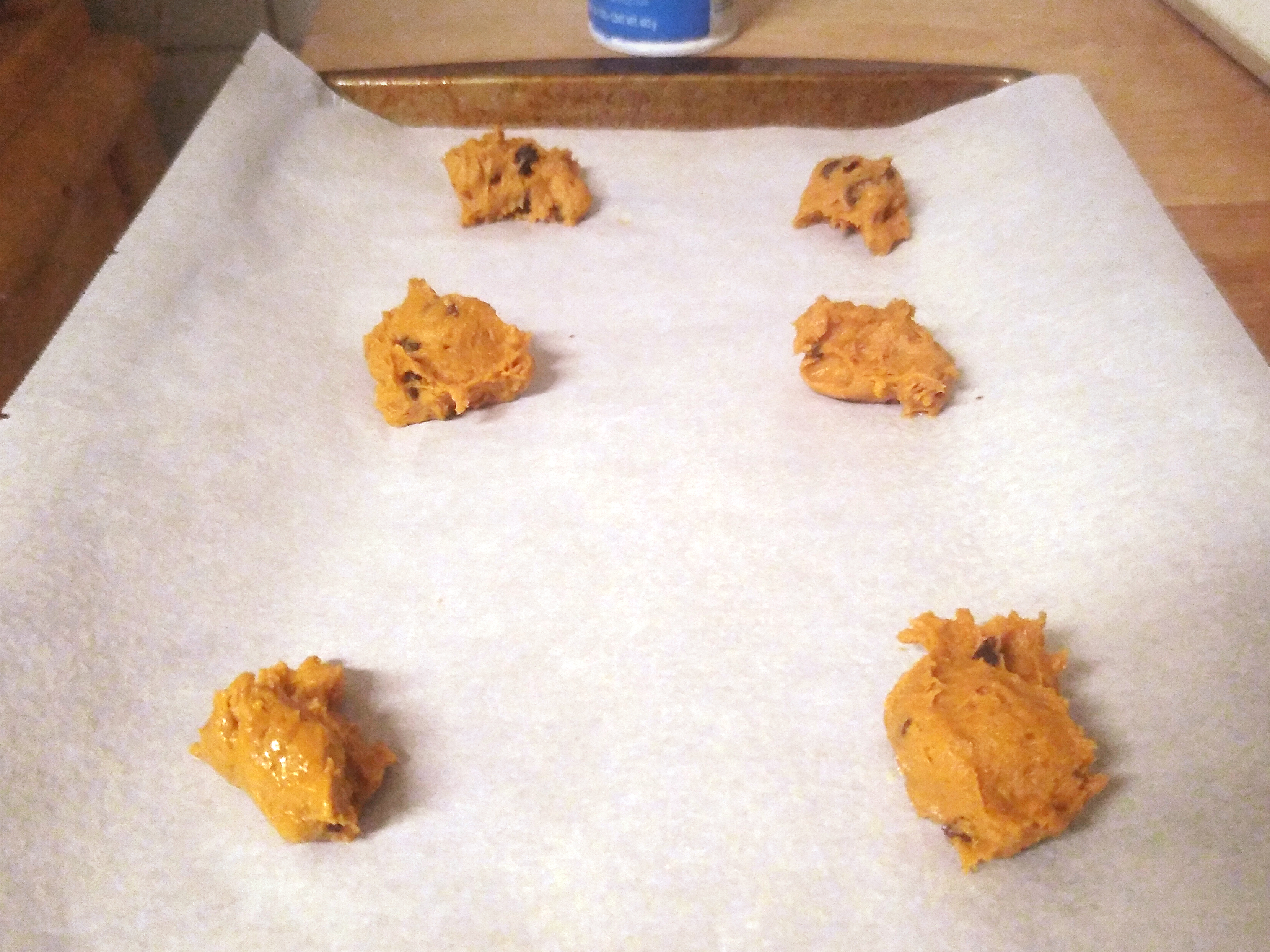
In baking the first batch, I applied a baking lesson that took me far too long to learn: don't crowd your friggin cookies! I have spent far too much time cutting countless batches of cookies apart, and now I realize it's easier to just accept that you will be spending a bit more time moving cookie sheets in and out of the oven. Since these cookies looked like they would really want to spread, I gave them so much space that they couldn't possibly merge even if they went completely flat. And just in case, I used the baking sheet that has raised sides. Barring a serious oven mishap, nothing would spill over the edge and burn on the oven floor. I needn't have worried about the cookies melting into a hot mess. They didn't spread at all.

In addition to being unusually well-behaved while baking, these cookies tell you when they're ready. When the raisins inflate like balloons, the cookies are done.


You just never know how cookie dough will act in the oven. Sometimes, dough that feels like hard clay in your hands melts into a hot sticky mess. And sometimes, the dough that is barely thicker than cake batter steadfastly holds its shape. 

As previously mentioned with the almond cookies, I have to wonder: did people in those days expect drop cookies to look like baked plops? Or did every recipe for drop cookies have an implied instruction to shape the dough a bit after dropping it onto the pan? Maybe people thought mound-shaped cookies were charmingly homemade in the 1930s.

In an attempt to make the remaining cookies look at least a little better, I flattened them before baking. The dough was extremely sticky, but I simply spritzed each dough-pile with cooking spray before gently patting them into something at least a little cookie-shaped. The extra dough-shaping didn't make as much of a difference as you might think, though the flattened cookies are a bit smoother and finished-looking on top.You can only see the difference if you put them side by side:


However, these cookies are very obviously from the pre-Instagram days of baking. I am fond of making recipes from the days when no one cared if their cooking would win points on social media. There's something so lovely and pure about making food meant to be enjoyed without worrying about whether it can compete on The 'Gram.

Whether I shaped my pumpkin cookies nicely or just dropped them off of a spoon, they were more like freeform pumpkin cakes than cookies. But they're good pumpkin cakes.  I didn't add any nuts to this batch (even though the recipe says to), but we all agreed that hazelnuts would be perfect. If you like pumpkin bread but hate the inconvenience of slicing it, these cookies are exactly what you never knew you could wish for. They are flavorful, and have that same rich denseness as a good pound cake. 

You can really see how cake-like they are if you split one open. I now want to quadruple the recipe and make the orange-colored, pumpkin-flavored bundt of my autumn dreams.


However, since these are more like freeform cakes than cookies, you have to store them accordingly. They go stale if you just leave them out on a plate or drop them in a cookie jar. So if you make pumpkin cookies ahead of time for whatever occasion prompts a bit of autumn on a platter, be sure to wrap them well. 

While we're on the subject of wrapping these cookies, you will have a lot of cookies to store. The recipe promises "three dozen good-sized cookies." I halved the recipe, measured the dough by the heaping half-tablespoon, and got... three dozen good-sized cookies. Clearly my cookies weren't good-sized enough for Mrs. M. Peterson. Perhaps the overly long baking time would have been correct had I made these cookies as big as she apparently did.

In closing, if you like pumpkin bread, you will like these cookies. They're basically muffin tops with no muffin stem attached. In other words, they're like pumpkin bread without the inconvenience of a plate and fork. If you want little freeform pumpkin cakes, Mrs. M. Peterson has you covered!

Thursday, November 3, 2022

Blitz Forte: or, It's as quick as a snap if you have modern electrical appliances!

This is the only recipe in the book with the name in quotation marks.

"Blitz Forte"
½ c butter*
1½ c sugar, divided into ½ and 1 cup
1 c flour (well-sifted)
4 eggs, separated
6 tbsp milk
1½ tsp baking powder
Whipped cream for serving

Heat oven to 300°. Grease a 9" square pan.
Beat the egg yolks well, set aside.
Cream the butter and ½ cup sugar together, beating until light. Add the well-beaten egg yolks and baking powder. Mix well. Alternately add the flour and the milk.
Spread the cake batter into the pan. (It will be thin.) Set aside.
In a separate bowl, beat the egg whites until light. Add the remaining 1 cup sugar, a little at a time, beating constantly until stiff and glossy. Spread the egg whites on top of the batter.
Bake for 30 minutes.
When cold, cut into squares and serve with whipped cream. Or, top with berries and cream for a shortcake. Delicious.

*Add ¼ tsp salt if the butter is unsalted.

Mrs. W. C. Dickey, Woman's Club of Fort Worth Cook Book (Fort Worth, Texas), 1928

This looked like one of those recipes where you're really glad you got everything ready before you began.

Before one begins the Blitz Forte, one must separate eggs. As you likely know, you really want to crack each egg white into a separate little containment bowl, allowing you to ensure that each one is 100% yolk-free before allowing it to join the others. We therefore needed one little bowl for the yolks, another for the whites, and a bigger bowl for the successfully-separated egg whites. Ordinarily this doesn't matter. But today, we could use the smaller egg white bowl for holding the pre-measured milk after separating the eggs. We may have a dishwasher at hand, but I still love any chance to reduce dirty dishes.

Pictured: economizing on dishwasher space!

I saw no point in beating the yolks, but Mrs. W. C. Dickey must have put that in the directions for a reason. As far as I can tell, we beat the egg yolks so they won't slip neatly out of the bowl, but instead leave an eggy residue behind. I didn't mind giving the dishwasher a little more egg to clean, but I was mildly miffed at the waste.


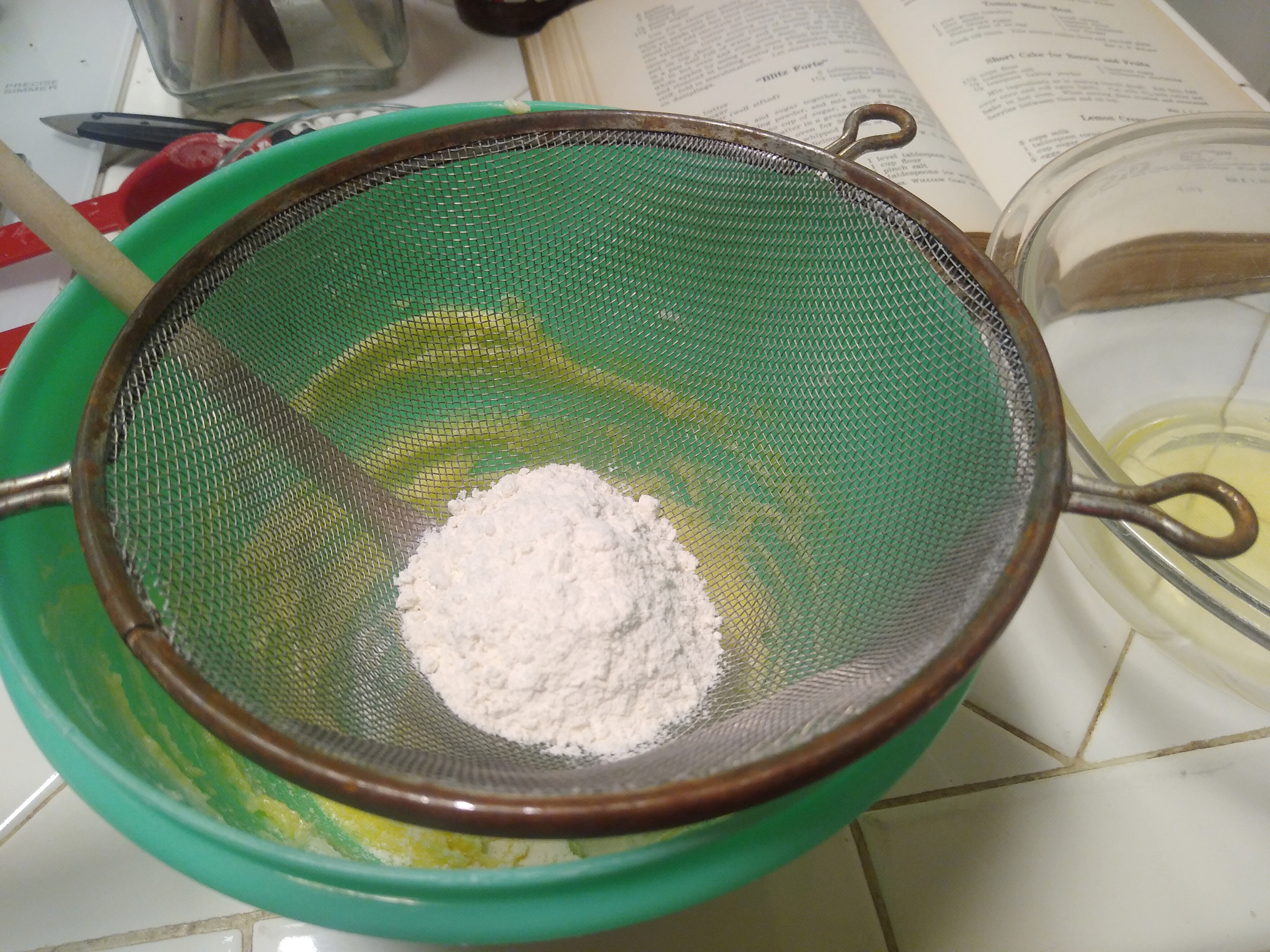
I rarely bother to sift flour (I know a few experts out there are horrified at the thought), but let the record show that I did indeed use a sifter after Mrs W. C. Dickey told us to.


At this point, we arrive at a slight conflict between recipe ingredients and instructions. The ingredients call for 6 tablespoons of milk which never get mentioned in the directions. I hazarded a guess that the milk was meant for the base layer and not the meringue. I've only seen milk go into whipped egg whites once, and that was the unexpectedly good diet mint pie. And that recipe used a lot of milk powder, so it basically contained milk concentrate instead of milk as it comes from the cow. 

In the Blitz Forte, all the flour-sifting and yolk-beating made the recipe seem like the work of someone who took every cooking commandment in her Home Economics textbook to heart. And as anyone who ever got a half-hour classroom critique on her white sauce can tell you, a meringue contains egg whites, sugar, a pinch of salt if you're daring, a splash of vanilla if you're sacreligious, and nothing else.


This part of a Blitz Forte looks like a cake batter, which made me wonder why the Blitz Forte is in the pie chapter.

Because the Blitz Forte recipe produced a tiny amount of batter even for a halved recipe, I got out the smallest pan in the house. As you can see by how paltry and puny the batter looks in the pan before spreading it out, I clearly made the right choice.


Now that the cake batter was made and gently coaxed into covering the entire greased pan, we could commence beating the egg whites. However, all this planning and preparation proved a waste of time. These two puny egg whites produced a lot more meringue than I expected. 


Now, one might think that in an era when you can get an electric mixer for nearly nothing at a thrift store, it's a lot easier to turn even the tiniest of egg whites into a cloud of meringue that would be the envy of every rival hostess in 1928. After all, in those days, electric mixers were still astonishingly expensive. So using a recipe that demands one was a flaunting statement.

Fort Worth (Texas) Star-Telegram, May 1 1933, page 12

As you can see, a mixer cost so much that they had to offer monthly payment plans in order to get the things out of the store. In case you're wondering, the price for that mixer adjusted for inflation is about $450 as of this writing, or almost two KitchenAids. 

Despite the price, I would wager that Mrs. W. C. Dickey had a stand mixer, even at 1928 prices. Take a look at this photo of the clubhouse from the front page of the book. I showed this to someone else who happened to be in the kitchen, and he said "Yeah, she could afford an electric mixer."

The club is so big they probably had to use a banquet camera to get all of it in the frame.

Back to the Blitz Forte. Now that we had an electrically astonishing amount of meringue, we had to bake it all. Hoping that mixing a little cooking spray into the cake batter wouldn't hurt anything, I transferred the batter into a larger pan. As you can see, a lot of delicate spatula work was required to persuade the batter to cover that vast acreage of sheet metal.


When I saw how much the meringue filled the empty space, I knew I was right to re-pan the cake batter. We have already plum-feta'd our way through self-sabotage by incorrect pan size. I would rather waste dishwasher space on an unused pan than deal with another pan-related baking misfire.


Gorsh, it was even puffier after it baked!


As you can see, the Blitz Forte collapsed a bit as it cooled. You should also know that people were slipping into the kitchen and "furtively" breaking off fragments of that lightly-golden crisp shell that floated on top.


I wasn't worried about the collapsed and unfortunate appearance of the Blitz Forte after it cooled. Mrs. W. C. Dickey already had a plan for that: whipped cream! As may others have noted before me, whipped cream covers a multitude of sins. But before we dress the Blitz Forte, let's see what we lifted out of the pan.


I did not expect that cracker-thin layer of cake batter to puff up into such a perfect-looking cake! Maybe the meringue insulated the batter enough to let the baking powder really push it upward before it finally set. Or maybe sifting the flour paid off.

But as successful (if not presentational) our Blitz Forte is, Mrs. W. C. Dickey does not think we're done yet. We have fruits to cut up. I love how the recipe says that if desired, we can "use for short cake with berries and cream." I didn't know that shortcakes used to be a common course when serving meals. Did people used to have main dish, salad, shortcake, and dessert?

At any rate, we have not served shortcake in so long that clearly we were overdue, so I got some fruits. Therefore, the Blitz Forte is not a dessert but a shortcake. 

I've always heard it's easier to peel kiwis with a spoon than with even the sharpest of knives, and it turns out that is correct. Look at how well we did on only our third try!


It gets hard to detach the skin from the kiwi when you get to the stem. Unless there's a counterintuitive kiwi-destemming trick I don't know about, I suggest you just chop it off and accept the minor loss of fruit. I tried to carefully excise the stem, and ended up taking a lot of fruit with it. We did not attempt this twice.


And so, with the Blitz Forte baked, the fruit washed and cut, and the whipped cream purchased, we could at last dig in! Everything about this is perfect. We have a dense yet not heavy cake at the bottom, a marshmallowy puff of meringue on top, and a lightly crisp layer of egg whites between the soft meringue and the cloud of whipped cream and the fresh fruits. Maybe you don't strictly need fruit on top of everything else, but it took perfection and made it better. Everyone who tried this was briefly at a loss for words. 

In other words, this recipe is absolutely wonderful. And, assuming you don't have to pay 1928 prices for an electric mixer, it's so easy and quick to make. After eating most of the Blitz Forte in an embarrassingly short time, we did agree that it would be even better with a bit of lemon in the cake. But this is so good that you needn't go out and buy lemon extract if you didn't have any.

In the event that we have company over who I actually like, I very well might make the Blitz Forte for them. It's a happy cloud of dessert bliss.

Sunday, October 30, 2022

Halloween Quickie: Candy Corn and Salted Peanuts

It's the most wonderful time of the year! A celebration of spiders, graves, skeletons, and lots and lots of candy! This brings us to one of my favorite treats of the season: candy corn and salted peanuts!


Candy Corn and Salted Peanuts

You don't need me to write out the recipe for this one. 

We had a surprisingly hard time making this because candy corn was unexpectedly elusive this year. Would you believe the supermarket didn't have any? They had happy little cardboard candy corn mascots holding up the price signs, but not a bag of those sugary wax-kernels in the entire building. We ended up getting our candy corn from a pharmacy.

Which brings us to candy corn and salted peanuts. Even if you don't like candy corn, this is just really good. Candy corn by itself is... well, it's okay. But if you mix candy corn with peanuts, you get something far better than either of the two featured ingredients could ever be on their own. The sweet-salty, waxy-crunchy contrast is perfect. Set it out at your Halloween party, or just make some for yourself. Thank me later. 

And so, with fondest wishes on the best day of the year, happy Halloween from A Book of Cookrye! Please enjoy my favorite ode to the most polarizing candy of the season:


Wednesday, October 19, 2022

Man-Sized Double Chocolate Cookies: or, The accidental cake

Today on A Book of Cookrye, we are following the recommendations of Pieathlon friends! As fiendish as some of us get (myself included) when picking Pieathlon recipes, the last time we got a recipe from someone who also did a Pieathlon, it turned out really easy and really good. Today, we are taking a suggestion from Poppy Crocker, who said we really ought to try...

Man-Sized Double Chocolate Cookies
½ c margarine*
2½ oz unsweetened chocolate
1 c sugar
1 tsp vanilla
2 eggs
2 c sifted flour
1 tsp baking powder
½ tsp baking soda
½ c buttermilk

Heat oven to 350°. Grease a cookie sheet.
Melt margarine and chocolate together. You can do this in the microwave (stopping and stirring every 15 seconds until completely melted). Or, you can melt them on the stove over low heat. Whether you use a saucepan or a microwave-safe bowl, use one large enough to hold all of the dough.
Add sugar, baking powder, and baking soda. Mix thoroughly. Add vanilla and eggs, mix well. Alternately add the flour and buttermilk to the dough. Mix well.
Drop by large tablespoonfuls (as in, 2 heaping tablespoons per cookie) onto the baking sheet, about 2 inches apart. Bake about 12 minutes. When cool, frost with the following:

       Chocolate Frosting:
2 tbsp margarine*
3 oz unsweetened chocolate
3 c sifted powdered sugar
4 tbsp milk

Melt margarine and chocolate. Blend sugar and milk in a small bowl. Add the hot chocolate mixture, mix well.
Let stand, stirring occasionally, until it's the right consistency to spread on cookies.
If it becomes too thick, add milk and mix well.

*Use the margarine that comes in sticks, not the spreadable kind that comes in tubs.

   Note:   You can substitute cocoa powder for unsweetened chocolate. For the cookies, use 5 tbsp of cocoa and and add an extra 2 tbsp margarine. For the icing, use 9 tbsp cocoa (that's 1/2 cup plus 1 tbsp) and an extra 3 tbsp margarine.
   Note 2:   If you double the buttermilk, this makes a very good chocolate cake. Bake it in a greased 9" square pan.

Our Best Cooky Recipes by Martha Logan, Swift and Company, 1962 via Grannie Pantries
These cookies come from a Swift and Co recipe handout credited to "Martha Logan." It seems that after General Mills found massive success with a fictitious lady mascot (I refer of course to Betty Crocker), other industrial food companies tried to come up with their own nonexistent women with names carefully designed to sound matronly. Swift and Co gave us "Martha Logan," who definitely sounds like someone I'd get a cookie recipe and borrow an egg from.

I'm surprised the Martha Logan people don't use lard in this recipe since Swift and Co specialized in meat and meat byproducts. Instead we use margarine, which I was only too happy to get because it now costs less than half the price of butter. For once, I remembered to set out the margarine so it could soften before commencing. Then I read the recipe, which says we are supposed to melt it.

Well that was pointless.

You may notice that contrary to the recipe directions, we are not melting chocolate alongside the margarine. Like many people, we at A Book of Cookrye went the more economical route and substituted in cocoa powder. After a quick stir, the proto-batter was as swoon-inducingly lovely as if we'd never fudged the ingredients.

Oh that looks good.

We never use buttermilk around here, and I was not about to purchase a whole carton of the stuff just to use a quarter cup of it and eventually pour the rest of it down the drain after it expired. We still had a bit of sour cream left over from the Piathlon. I figured if I used half that and half water, it would theoretically average out to buttermilk.

Dumping water into chocolate batter looks wrong, doesn't it? Any time I add water to a recipe it feels like a mild transgression. I know that makes no sense. After all, the milk in cake batter is like mostly water. But for some reason, pouring in colorless, odorless, tasteless water feels like I am messing with that which oughtn't be messed with.

Oh, the ruination.

Well, it turns out adding the water was wrong. Due to mathematical carelessness, I halved all the ingredients except the buttermilk. Watering down the cookie dough made it uselessly runny.

Never has something so wrong looked so right.

With the cookies already ruined and the oven already heated up, we had 4 choices. Our first choice: put the "cookie dough" in the refrigerator and hope it hardens like the chocolate frosted drops. Second: hastily mix all the non-buttermilk ingredients, combine the two batches, and hope it averages out. Third: throw out the whole business and deny everything. Fourth: put what we have in a cake pan, which might turn out terrible but would at least be contained from spilling in the oven. 

I went ahead and commenced the icing as soon as I closed the oven door on our impending failure. In theory, the icing could "let stand, stirring occasionally, until of right consistency" while the not-cookies baked and cooled. When I mixed the powdered sugar and milk in bowl #1, I began suspecting that the icing would need no standing time. The icing already stood on its own before we added the chocolate to it.

Kind of looks like soft-serve, doesn't it?

The finished icing reminded me of the boiled blackberry pudding. Its instructions tell you to add flour "enough to make the spoon stand in the batter." 


Meanwhile, the "cookies" had defied my expectations. I thought we would get a dense, brownie-ish chocolate thing, but instead we got a puffy, airy-looking chocolate cake.


As I waited for the surprise cake to cool, a number of people approached the icing bowl with spoon in hand. I have never seen anyone look so happy from a tiny spoonful of icing. This tasted like the best fudge you ever made. I think it would be amazing spread between two yellow cake layers, or on top of cupcakes. But since I didn't have any of those at the moment, I spread the icing on this chocolate cake instead.


The icing was hopelessly, unworkably thick. You may as well try to smear modeling clay on top of a cake. I know the recipe says to thin it with a little milk if needed, but the icing was so rich, so fudgy, and so creamy that I couldn't tamper with perfection. Instead, I microwaved the icing until it melted a bit.

This is the most diet-friendly chocolate cake I have ever made. By "diet-friendly" I mean large pieces of cake kept disappearing whenever I wasn't looking. Chocolate cake cannot tempt you when it's already gone. You would never think such a delicious cake was a recipe error. It was light and airy in texture, but marvelously rich and dark in taste. People were asking when I will make the cake again. Because I can never keep my yap shut when I nearly ruin food, I of course blabbed that this delicious cake was supposed to be cookies until I did not correctly halve all the ingredients. The response: "Well, you need to make that mathematical error again!"


But we weren't sent a cake recipe. We were sent a cookie recipe. And I wanted to see what happens if we make the recipe again, but actually follow the directions. The resulting cookie dough, if you actually use the measurements given in the recipe, was ever-so-slightly runny. Like, it could almost hold a shape, but it drooped if you held it on a spoon for very long.

I contemplated refrigerating the cookie dough, but the recipe does not tell us to. Presumably the staff at Swift and Co's test kitchen thoroughly tested this recipe, and determined that we need not involve the refrigerator. But in case these cookies spread out a lot, I gave them far more space than I usually do when baking. I also deliberately used a cookie sheet with raised edged on all four sides because I was almost certain that a hot drippy mess awaited after a few minutes in the oven. I know that drop cookies are a bit runnier than the ones you have to properly shape before baking, but these seemed... well, too runny. Or maybe I was just worrying too much after I ruined the previous attempt at this recipe.

The cookies didn't even slightly slump in the oven, much less spread out. I would say you should flatten these a bit if you want them to look more cookie-like, but you would probably end up with a sticky mess instead. If I felt fancy, I might pipe this cookie dough out instead of just spoon-dropping it.


They're such near-perfect domes, aren't they? I was a bit disappointed they didn't spread out and look a bit more, well, cookie-like. But we have to discuss something about the recipe results. Here is our lovely tray of cookies right after we turned off the oven and put away the pan. You will note that we had to get out the big platter.


We have 17 cookies on this tray. Keep in mind that we halved the recipe, meaning we should only have nine of them. This is a rare moment at A Book of Cookrye. Between my deliberately terrible bowl-scraping (if you don't leave batter on the bowl to lick, why did you even start baking?) and my habit of measuring portions of cookie dough with a far more generous hand than recipes tell me to, I almost always get far fewer cookies than the purported yield. However, I got nearly twice what this recipe says I should have. Clearly my cookies aren't man-sized enough, and I will have to make them big enough to use as dinner plates next time.

You should know that I doubled the icing recipe and figured any extra could go into the freezer. This is all the icing that was left after the last cookie was properly dressed. Note that I had to get out the rubber spatula before instead of after finishing the cookies.


So if you're going to make this recipe, I suggest you double the icing (I already doubled the amounts when I typed out the recipe). You can just put any extra in a plastic bag, squeeze out the air, and freeze it until you want it. But unless you spread it very thin, you may not have to worry about surplus icing any more than I did.

But enough about that. Look at how delicious these are!


As we ate them, one person said "Yeah, I can see how these turned into a cake last time." These cookies are like eating the tops of cupcakes. 

The only thing I didn't like was that I didn't have anywhere to go and give these away (keep in mind that we accidentally made twice as many cookies as we planned). But these were just as diet-friendly as the cake made from the same recipe. One person said "Great. Now I'm going to keep stuffing my face with these until they're gone." Another person ate one, immediately looked blissful, and simply said "Good cake-cookies."

I very likely will make these again. It's nice to know that I can make delicious chocolate cookies without endangering the wreckage of my pre-pandemic figure because everyone else likes them as much as I do.