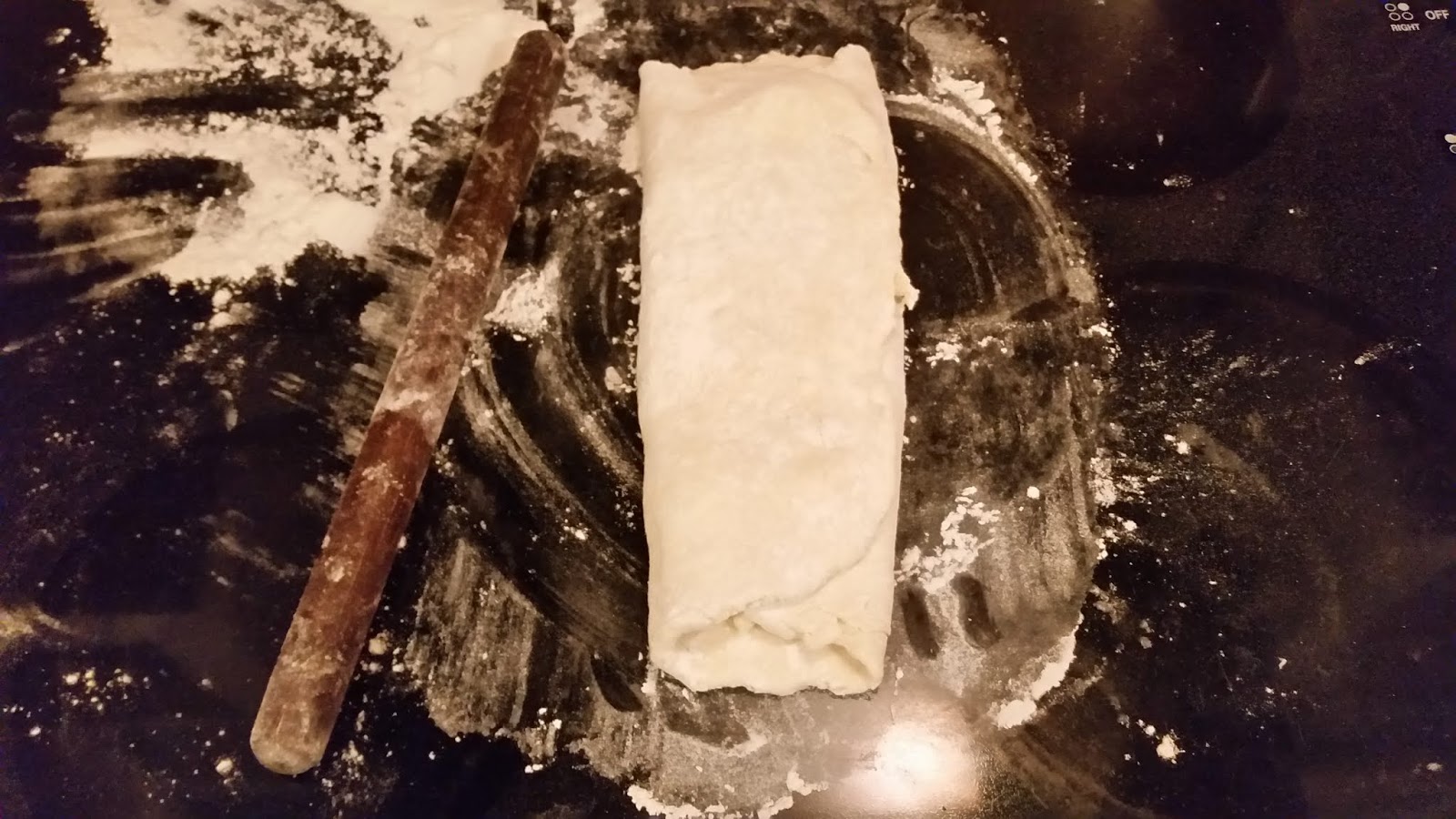
We at A Book of Cookrye, on the marvelous generosity of friends whose
jobs may or may not include generous flight benefits, have once again
flown to a country where there are still pay phones!
 |
| You get some interesting looks from airport staff when photographing the walls. |
Apparently we managed to avoid irking our wonderful friends in Ottawa who so graciously
brought us there for an international adventure.
They invited us back again! This time it was because it's Winterlude,
the city's big winter festival. Actually, we tried to go last year and
the year before, but each time something got in the way of freeing up
enough days for a visit.
Which means we had to wait until now to return to the country where we discovered our favorite fry condiment!
As this is A Book of Cookrye, let's examine the gastronomic delights that await those who venture to the northernmost country on the Americas!
 |
| Current Snow Level: You won't see the curb until spring. |
When you arrive in Canada, you needn't even leave the airport to realize that things are different than in the United States. You may decide to wait for your ride at one of the restaurants, where you notice that extinct American brands are living a Canadian afterlife.
Upon deciding to stop at the grocery store, you will find that Canadians get bigger sandwich cookies than Americans do. And that may feel like a great injustice.
 |
| The cookies sold in America do not cover an entire soda can. |
If you feel indignant that not only do Canadians get free healthcare but also bigger industrially-made cookies, your bristling ire may not be assuaged when you see that they make even more expressive use of cute mascots on their food than Americans do.
 |
| There are no Kraft peanut butter bears in the United States. |
Apparently Canada has stricter requirements on food labeling than America (did you know that in the US a Tootsie Roll legally qualifies as chocolate?). For example, they do not use "cream" anywhere near that powder we add to coffee. Instead, they employ a name that more accurately describes its purpose.
Note that we at A Book of Cookrye are not casting judgement on those who use heavy amounts of the stuff. (How could we when a coffee made to Book of Cookrye standards looks like
this?) Elsewhere in stores, we find adorable loving self-deprecation of one's own country.
 |
| Don't you love how the prices are both by the metric system (actually by the underrated hectogram) and by the pound? |
Perhaps because I am an American and they wanted to make me feel at home, it turns out that the first grocery my friends took me to was full of mostly candy and junk food. Most of the things with actual nutritive content (aside from the hazelnuts in the Nutella) were pushed to the back wall. And even then, right next to the hazelnut and sunflower butters was a BUCKET OF SYNTHETIC ICING SOLD BY THE POUND.
 |
| The "White Buttercreme Icing" contains neither butter or dairy of any other kind. |
But this was the biggest surprise we found while browsing all the sugary goodness: Smarties! You know how in America they're these chalky things that seem to only appear around Halloween? Sort of like Sweet-Tarts without the tartness or the artificial flavoring? It turns out that for the rest of the world, Smarties are chocolates! Imagine if you will an M&M, only it's
really big.
My friends, seeing me take perhaps too much time to marvel over a bin of non-American Smarties, were like "Uh... are you all right?" Imagine your reaction if you brought someone over to see your new house, and instead of being amazed at all the decor and furniture, they spent the entire time admiring the light switches.
 |
| You're looking at discounted Valentine's Day Smarties, hence all the pink. |
Photographed to the left of the Smarties (which of
course we bought a lot of) is something I can't believe was sold in stores. Have you ever been to a church potluck? You know how there's always at least one person who brought something made from a recipe that looks something like "Melt a bag of butterscotch chips, and stir in one sleeve of broken graham crackers..."
...Yes. The store sold church-lady squares in bulk. It's one of those things I can't imagine anyone purchasing. It seems like something you'd make from one of the worn out, spiral-bound community cookbooks our Pieathlon friend
Poppy Crocker lovingly writes about. Also they were utterly addictive and we should have bought a bigger bag.
One of the things that still takes me a
bit aback is that so many Canada-based businesses will make damn sure
the signage tells you where you'll find their headquarters.
 |
| We at A Book of Cookrye salute this store for offering so many bargain-priced ways to develop diabetes! |
The last time we were in Canada, we were informed that Canadians may not
be polite so much as passive-aggressive. This was confirmed upon
viewing the signage at the grocery cash registers.
 |
| I can just hear the ever-so-slightly-sarcastic tone one would use when saying this to a customer who apparently didn't realize that cash register was unstaffed. |
Elsewhere in the grocery stores, we found that no matter how much we try to accustom ourselves to seeing even the most everyday and ordinary things labeled in French (rather than just the French-looking expensive stuff that we see thus labeled in the US), there are some spots where seeing French labeling will always looks a tetch out of place. Maybe it's because in America, French is used when people want to add extra snob credentials to something; whereas in Canada, French is simply a language.
 |
| Tacos are like Chinese food in that everyone in the world has discovered that they're amazing. |
Speaking of tacos, you may be interested to know that Taco Bell has refused to open a single location in Quebec. You see, the Québécois go above and beyond even the national government in putting French alongside English wherever anything is written down. In Quebec, you are legally required to not only label everything in French, but to put the French
above the English. Taco Bell, in a display of all-American French-bashing unseen since the great
Freedom Fries debacle, has decided that they would rather refuse the entire Québécois population (that's about 23% of Canadians-- or almost one out of four-- assuming
Wikipedia is correct) than put French on their signs. (Incidentally, there seems to be no consensus on how many accent marks go on the word Québécois.)
Speaking of tacos, our friends decided that on our first evening in Canada, we were going to get... Mexican food! In Ottawa! We at A Book of Cookrye have often mentioned how we enjoy finding how the foods we know at home change when we go abroad. Therefore our friends knew how much we would love journeying north of the border to eat south of the border.
 |
| The signage looks just like something you'd see at a burrito restaurant in the US. Only when you notice that they felt the need to declare that they use no MSG before they mention the fresh ingredients do you know you're in a different country. Mexican(ish) restaurants in the US never even mention avoiding MSG because no one ever thinks they'd use it. |
The restaurant seemed very much like the ones we'd find at home- aside from a few tiny details which suggest we were over a thousand miles away. You know how in the US, it's common to see little charity things at the cash register? You know, those ones with a picture of a hospital patient above a little bucket for coins? Canadians have chosen the perhaps more lucrative tactic of making you feel with charitable with chocolate. I saw these little candy baskets at cash registers at
many restaurants and stores, each stamped with a different charity's logo.
 |
| Apparently MADD Canada (among many other groups) has decided that candy succeeds where pictures of crash victims fail. |
I don't know if I was disappointed or happy to find out that franchise burritos taste the same in Canada as they do in the US. They even got the near-absurdly huge size right.
 |
| You may think that soda bottles are smaller in Canada than the US. They are not. |
For the curious, a burrito in Canada is exactly the same as what you'd get in the United States at the franchise of your choice. However, up here they have what they call a "burrito sauce" to go with it. Such a thing's existence surprised me. It's like if I went to a
drive-thru at home and they asked "Want hamburger sauce with that?"
 |
| It's basically chipotle mayonnaise. |
Elsewhere in Ottawa, one finds that the American Southwest is apparently very popular in the snowy north.
Note
that one of the burritos is described as "handheld." This implies that
they sell burritos that are too big to actually lift one-handedly (or
even two-handedly).
Like the last time we encountered Mexican(ish)
food two national borders north of Mexico, we find that they are a lot
bigger on presentation than one might be in the United States. Like,
they literally crown their chili with chips.
 |
| Let us salute our friends who put up with us not only taking pictures of our own restaurant orders, but also photographing those of everyone else at the table. |
For
the curious, it was actually pretty close to what one would find if one
went to Texas- the biggest difference is that they used relatively big
chunks of meat. Also, they served it with chips, which we have never
seen in the United States.
Elsewhere in Canada, one finds that restaurants trust their diners to be able to actually cut up their own plate of meat. We went to three restaurants that served us a piece of chicken that looked like this.
I've never seen any restaurant in America just put the back half of a chicken on a plate like this. In America, you
rarely see any piece of chicken with bones in it at all (aside from the legs), much less something that requires such extensive use of a knife and fork. And yet Canadian menus serve this very matter-of-factly. Apparently in other countries, people are more accustomed to cutting up their own dinner after it arrives to the table than Americans.
Now, a lot of the other Canadian culinary delights we discovered make more sense when you realize that outside looked like this:
 |
| Current Snow Level: Bus stops require excavation. |
And so, without further ado, let us go to a restaurant where they
felt the need to stamp the silverware!
You'd
think that a restaurant called Swiss Chalet would have like four pages
of fondues on the menu, but they did not. They did, however, have our
favorite thing we've ever dumped on French fries:

Our friends were the most excited to get us something called Beaver
Tails. During the many weeks of texting back and forth about this trip, excited notes like "I can't wait to show you beaver tails!" came up a lot. And they were so right to be so jazzed. Beaver tails are so good that despite the fact that the snow looked like... this, there was a long line of people in front of the
tiny little sidewalk stand that sold them.
 |
| Current Snow Level: The trash cans may soon disappear until May. |
And what, gastronomically speaking, is a beaver tail? Well, you know those fancy doughnuts with extravagant toppings? Well, imagine one of those flattened out like a fried pizza crust, leaving more room to put even more things on top! We'll let the menu (and the calorie counts) speak for itself.
 |
| To my vexation, I was informed that the maple one was probably artificially-flavored DESPITE THE FACT THAT THIS IS CANADA. |
The woman behind us in line had apparently never had a beaver tail either, because she was reading out the list, gushing over how divinely delicious every single option looked. We at A Book of Cookrye were no better than she, and wanted to enquire about getting the exact one on the picture with a little splot of every single one of their topping choices (including the garlic-parmesan) so we wouldn't have to actually choose just one.
You may think that they had made an extra-large one for the sake of photographing all their entire menu. They did not. Here is one, with my hand under it for scale. Note that all that fried divinity near-completely conceals my hand. When I got the cinnamon-lemon one (which I picked because I had no idea if it'd be any good), I expected a sort of artificially-flavored lemon glaze with cinnamon in it, not something with actual lemon and real cinnamon.
 |
| They called it Killaloe Surprise. I think the surprise is that cinnamon and lemon are really fricken delicious together. I'm already thinking of ways to bring cinnamon and lemons together in future kitchen misdeeds. |
However, no discussion of the food of Canada is complete without...
Before we get to the dish itself, let's have a look around the restaurant.
I keep thinking the "industrial" look will become played-out and dated soon. You know how any trend (whether it's clothes, interior decorating, gardening, or anything else) becomes old as soon as everyone's doing it? You know, the whole "Now that
everyone has one of those [insert brand here] purses, I don't want one anymore" thing? Well, apparently that saturation hasn't happened yet for the industrial look. Our fashionable restaurants still look like abandoned factories.
 |
| The place is empty because apparently even most Canadians don't get poutine at 11AM. We got some interesting looks from the cashier. |
Between two-handed fried doughnut things and... this, I'm amazed that it is the US that introduced the world to obesity epidemics. Now, as Wikipedia will tell you, poutine is simply a dripping, steaming ooze of French fries, cheese curds, and brown gravy. However, people will put whatever they want on top.
Think of one of those trendy new pizza parlors that have
extremely customizable pizzas. Now imagine a heavily-loaded pizza from one of those places-- only instead of a pizza crust and tomato sauce underpinning everything, you have a mass of cheese and fries and gravy.
 |
| Of course I ordered what they called the Canadian poutine. It has mushrooms, meat, onions--- and maple syrup. Because Canada. |
Honestly, poutine really seems like it should be inescapably popular Stateside. Like, you'd think that most of your burger drive-thrus would have it as a standard menu item. It is one of the most aggressively all-American dishes ever to be invented outside of the United States. Honestly, why
haven't Americans discovered fries utterly drowning in cheese and brown gravy? Is it unpopular because the name sounds French? Is it because it's from Quebec, where a lot of people refuse to speak English?
Whatever. The
really good part of eating one of these is when you get to the fries and cheese that have been marinating in the gravy for a while.
 |
| Looks like a dog's dinner, tastes amazing. |
A lot of the lovely (yet ever-so-heavy) Canadian food we had made a lot more sense in the cold. (That and no one can see the effects of it once you are wrapped up in all your winter finery.) And just how cold was it? It was so cold that no one gave me any weird looks for going out in public looking like this!
 |
| That scarf is twice my height when unwrapped. |
Even after only a short time, you get so used to the cold that you no longer get astonished just because the water bottles in your car's map pocket have frozen overnight.
Seriously,
as we were getting in the car one frigid morning, someone brought out
soda cans for the ride. We took a sip and exclaimed "Ooo, this drink's
so nice and warm!" And indeed, as if we'd been handed hot chocolate, we could feel ourselves warming up as we drank.
A look of mild amusement ensued, followed by ".....I just took it out of the refrigerator."
 |
| Current Snow Level: Sit down and your fun bits will get frozen off. |
It is so cold that while people in less-wintery climes may spend a long time with a calculator determining if new windows will save enough on bills to cover the purchase cost, the city of Ottawa decided to pay for them for you in the name of energy conservation (obviously it's not that simple, but this is A Book of Cookrye, not A Book of How To Get Government Reimbursements). So most houses, regardless of style, age, size, etc have the same new-looking white windows. It can get surprisingly jarring to the unaccustomed to drive past whole neighborhoods where some houses look 50 years old, some look new, some look like like they were built in the 1800's, but all the windows look the same (and they all look like they were installed last week).

In Ottawa, your house is only drafty if you want it to be. As we currently reside in a house that manages to be horribly drafty right until you burn dinner (at which point it holds onto the dreadful smell even if you open all the doors), it was a sublimely delightful experience staring out on the wintery majesty without having to bundle up indoors.
 |
| Current Snow Level: It's a marshmallow world! |
However, no matter how much we thought to ourselves that we were
totally getting used to the cold, we were reminded that we did not have
the years of experience in Canadian winters that Canadians have. While
pedestrians were dodging falling icicles, this tea house was advertising
that they sold "the perfect summer refreshment!"
All this attempting to walk on ice without falling can drive even the most cold-hardy person indoors, which brings us underground!
My friends were really excited because they'd found a destination they knew I would absolutely love: an actual Cold-War bunker! Ottawa, is of course the national capital. As the cold war was heating up, the nation's leaders decided to build a bunker to which they could hastily relocate the national government in case things went nuclear. Among all the drearily-painted offices (this is a government facility), said bunker had an Atomic Era kitchen display. Maybe they wanted to have a suitable backdrop for another
Kitchen Debate in case the Russians visited.
At first glance it looks like any 1950s model kitchen, stocked with the latest in wares and appliances. It could be from the pages of an old department store catalog, or something for a magazine advertisement. Then you look at the window and notice that they decided to put the "atomic" in "Atomic Era."
 |
| Don't you love how the adorable mushroom cloud is color-coordinated with the cabinets? |
And (in the odd chance that this kitchen was ever intended for use) where might one store ingredients? In the freezer which handily doubles as a morgue, of course!
Moving on to facilities people actually used, the showers looked a lot more like what you expect to see in a Cold War bunker.
As anyone who's read some of my
very previous entries knows, I did time in engineering school (
see here for a tiny sample of my actual math notes). Engineering students have an unfortunate habit of not bathing. If you enter the engineering building of any school, a distinct fermented funk whaps you in the nose. It's worse than locker rooms- after all, people who've been exercising may smell bad, but at least they wash off their sweat rather than marinate in it for months. This has given us at A Book of Cookrye an almost superhuman tolerance to foul smells, and a deep and abiding love of frequent and long showers. With that said, in a world where most new showerheads have water restricters in them that reduce the flow to a dreary trickle, you can look at this thing and just
know that it spews an absolutely righteous deluge of hot water.
 |
| I wanted to unscrew it and take it home. |
Speaking of things I wanted to take home with me, I could not find where everyone was getting these Winterlude stickers from. They were all over lampposts and buildings whenever we went out, but I couldn't find where to obtain one. So I never got one at any point during my visit.
They had some strange exhibitions like these VHS tapes that could have come from any thrift store, here safely encased in Plexiglas for all to behold.
The also had a fascinating biography of a Russian man who spied for Canada, which for some reason they displayed under a mannequin that looked like an entrant in the Miss Lovely Eyes beauty pageant.
 |
| If you like weird history and haven't looked up beauty contests of yore, you really should. |
But for fans of interactive history visiting the Diefenbunker, nothing can quite top... this!
Yes, you can actually seek relief just like a 1960's government worker fleeing nuclear bombs. After wandering though long halls lined with rooms full of roped-off artifacts and things you are not supposed to touch, lowering your longjohns on history is a strange experience.
I've never seen such a large public bathroom (or, since we're in Canada, it's a washroom) anywhere. I've been to plenty of places that
needed one, but this is the first place I've ever been to that actually built one.
Those round silver tanks go to something I've also never seen in a public washroom: centrally-piped hand soap.
Apparently your average 1960s government worker was a lot better about hygiene than your 21st-century engineering student. They even assumed everyone would be shaving. Each sink had a labeled outlet so that no one would have to resort to a non-electric razor while the bombs fell.
By the way, these lavish bathrooms are what exposed the meant-to-be-secret bunker's existence while it was still a construction project. Some nosy journalists wanted to know why the government suddenly needed so many new toilets.
 |
| Please note that the reporter came back and signed the Plexiglas on top of the newspaper. |
Speaking of things that aren't washrooms, I would like you to know that when we saw this room, one of my friends groaned that he spends a lot of his working days in a conference room just like this.
Apparently the only difference between this room and the one where the aforementioned friend attends a lot of meetings today is that they no longer have massive tube televisions hanging off of the ceiling.
I always found suspended tube televisions unnerving. Especially the big
boxy ones like this, with their little rubber feet dangling midair with nothing to rest on. They look like they should be firmly planted on a
very sturdy table, not hanging over everyone's heads looking ready to
come down at any moment with a very heavy crash.
On a patriotic note, all of the televisions were ordered from a Canadian manufacturer. In a very Canadian postscript,
their Wikipedia page does not state that the company went out of business. Instead, they "underwent an orderly wind-up in late 2008."
Speaking of subtle things you don't realize until you've left
your country, we had never considered the extent to which public spaces
in America are designed with the implied assumption that the general public is full of jerks.
This is the coat check room at the bunker. Notice
anything missing?
That's
right, there's no one there to monitor it against theft. It seems that in Canada, people will not only leave other
peoples' coats alone regardless of how theft-worthy they are, but they
don't even start picking through the unattended pockets. Did you think
that all coat checks in America have attendants for the sake of keeping
it classy? They have attendants to make sure you don't decide someone
else's coat looks a lot better than your own!
Such
implied trust in customers and visitors extends to a lot of other
spaces. This restaurant had light switches placed right out in the open.
Apparently in Canada, neither pranking teenagers, drunk adults, nor
undisciplined children ever mess with the lights. You do
not
see that sort of implied trust of your customers in America. If
thermostats or light switches are not hidden in the back office, there
are locks over them.
As we returned outside, we at A Book of Cookrye haven't seen this much snow in years. It even made the roadside gazebo store (apparently those exist) look positively picturesque. It's a whole Victorian of gazebos in the snow!
 |
| Actual in-car conversation: "Get a picture fast because we are NOT stopping to take pictures of gazebos." |
Assuming you brought a decent coat, it's amazing how quickly one adapts to the cold.
 |
| Current Snow Level: Even the handicapped need a shovel. |
But we're only just getting to what excited us the most: Skating!
A canal runs through Ottawa and freezes hard enough to skate on. As they proudly advertise, it is the world's longest naturally-frozen skateway (
which is even a UNESCO world heritage site!). People have always taken to skating on the frozen canal in the wintertime, and eventually the city decided to make it an official attraction. This includes setting up skate rental shacks, where we saw that even handwritten signs are in two languages.
Naturally, we absolutely had to have a go at it.
 |
| I needed help getting the skates on. |
If you are going to attempt to ice skate outdoors, it helps to know how to ice skate. We at A Book of Cookrye, naturally, do not. We've only had the occasional expedition to the ice rink at the shopping mall nearby, and even then we could never let go of the rail. You may not be surprised to learn that if you're attempting to skate outdoors, there's no rail to cling to (assuming you have any feeling left in your hands). They do, however, have fires right on the frozen canal.
It is so cold that the fire was not slowly melting a hole in the ice. And before you think that was just a few puny pieces of smoldering wood, check out and compare the size of the people huddled around it.
If you aren't in the mood for trying to glide across ice using knives strapped to your feet, you can rent a sleigh instead. Based on the snow cover, we will guess that sleighs were not very popular.
We, naturally, did not want to get pushed about in a sleigh. We wanted to attempt to skate for ourselves. And, while we didn't get far, we did somehow manage to stay upright. (We fell several times
walking on the ice, so not falling while
skating is quite the feat.) However, if you've never skated before and therefore keep wobbling and flailing about, few things are more unnerving than other people approaching. I did not want to accidentally crash into an innocent by-skater.
 |
| In this giddy moment, just after I got the hang of it, I forgot that I was wearing an extremely vintage coat which I would never forgive myself for tearing if I fell. |
Had it not been a bit expensive to keep adding an extra hour to the skate rental time, we might have actually gotten a good ways up the canal. That and our ever-patient friends were waiting in the cold the whole time we were attempting to skate. If you are going to attempt to skate for the first time, remember to wear puffy socks that go higher up than the tops of your skates. If you do not, the backs of both your legs will look like this.
 |
| Quoth one of my friends: "These are like badges of honour for Canadians." |
Coming as we do from the American South, it was an utter delight to find out that some parts of Canada turn into a genuine
winter wonderland! Like, we just snapped this photo on the side of a
bike trail. We did not hike a long way into the countryside. (Would you want to in this cold?)
 |
| We hereby release this photo for Christmas card use. |
The
last time we went to Canada, it was in the balmy autumn and the weather
was so beautiful you wanted to open all the windows and put your bed
outside at night. We honestly could not imagine that in a few months everything would look like this.
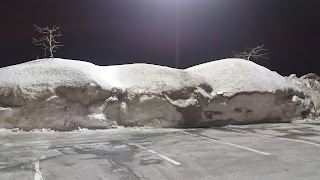 |
| Current Snow Level: there are snow-dunes with geological layers. |
You know what? Let's talk about all this snow! We spent most of our time admiring it. On our last visit, we noted that the fire hydrants had those almost absurdly high signs above them. Our friends had said the signs are there because the snow gets so high that without the signs, no one would find the hydrants in the snow. While we couldn't imagine such a thing, we now have photographic proof!
 |
| In the winter, you need a even snow shovel if your house is burning down. |
You know what's utterly incredible to someone coming to an Ontario winter from the American south? The way the they are totally prepared for snow. Where I come from, they shut schools down if the grass gets a light dusting of white powder. But here in the frigid north, all of the streets looked like... this.
 |
| The ground is actually flat underneath all those dunes and white cliffs. |
And yet,
no roads were closed off. More astonishingly, people actually know how to drive on the ice! Where I come from, if there's even a light glaze on the road, you are better off staying home because otherwise some idiot absolutely will rear-end your car. Furthermore, you don't see nearly as many huge cars as you might expect in a city where one must routinely drive on ice. Looking out as we drove, we saw a lot more tiny hatchbacks and sensible compact sedans (most of which did not even have 4-wheel drive) than big trucks and off-roading rigs- and no one was even slightly skidding. Though if you
do drive such a large vehicle, the added height comes in handy when you're not quite sure where the curb is under all the snow.
 |
| Current Snow Level: Even the snowmen have unfortunately-placed frostbite just below waist level. |
|
It turns out that when your city gets snowed in every year, you can't just panic and put your life on hold until the snow melts, which is what people do in the south. And so, the city brings out the big guns to keep the streets cleared and driveable. (Incidentally, my friends are by now so used to me photographing every
little thing that when I came back in and said I was watching the snow
plows, no one was surprised.)

Not only does Ottawa excavate the streets, but they also plow the pedestrian trails that thread through the city. Coming from a country where sidewalks are an afterthought, seeing this kind of accommodation for pedestrians was a shock. However, you may notice that while the pathway is clear, it is nonetheless completely glazed with a slick coat of ice. Having never mastered the skill of walking on ice, we were wobbling in our shoes and frequently making pratfalls. Meanwhile, people around us were walking their dogs! Like, not only could they keep their balance on ice, but they could do so with bulldogs and collies pulling at their leashes!
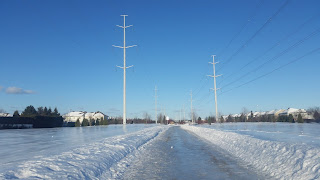 |
| Current Snow Level: Anyone attempting snow angels will get buried alive. |
But anyway, all of this snow goes in dump trucks to a snow dumping ground not too far out of the city. There it is all piled up in a big mound that can take until July to finish melting. (I know you are as curious as I am to see the summer snow mountains of Ottawa. One of my friends said he'd try to get out and get a picture.)
On a horticultural note, we were informed that there is little point in planting deciduous trees. They'll survive the winters (maybe), but they will grow tediously slowly because the summer is so short. Just as soon as the leaves reach full size, it's wintertime again and the tree must drop its barely-matured crown of green.
 |
| Current Snow Level: Your trees are now bushes. |
And so, all too soon, we at A Book of Cookrye had to bid goodbye to our wonderful friends and to a wonderful time of ice-skating and snow. On the bright side, it turns out Air Canada gives away free maple leaf souvenirs! They don't even ask if you're flying home on their planes!
And so, we returned to the United States. In a polite display of Canadian passive-aggressiveness, the little airport snack store decided to use Asian wisdom quotes to make us feel bad for failure to purchase a drink.
But we at A Book of Cookrye would like to thank our wonderful friends for once again welcoming us. We had a truly lovely time, and next time we will hopefully remember to pack something better than sandals!