Thursday, May 6, 2021

Brownies from Nuns

Today on A Book of Cookrye, we are making brownies that are apparently endorsed by nuns.


Fudge Frosted Brownies
½ c butter
1 c sugar
2 eggs
2 oz unsweetened chocolate, melted*
1 tsp vanilla
½ c flour
½ c chopped walnuts if desired
       Fudge frosting:
1 c sifted powdered sugar
1 tbsp cocoa
2 tbsp cream
1 tbsp butter

Heat oven to 325°. Grease an 8" square pan.
Cream butter and sugar. Add eggs one at a time, stirring well after each. Blend in the chocolate and the vanilla. When all is mixed, add the flour and nuts.
Bake 35 minutes. When they're done, press the brownies with the bottom of a glass to level the top. Frost when cooled.
       To make the frosting:
Mix the ingredients in a saucepan. Cook until the pot boils around the sides. Remove from heat and beat until it is a spreading consistency.

*If you don't have unsweetened chocolate, use 6 tbsp of cocoa powder. Increase the butter by 2 tablespoons. Stir in the cocoa powder with the sugar.

Dominican Sisters (Oxford, Michigan), Anniversary Slovak-American Cook Book, First Catholic Slovak Ladies' Union, 1952


It's weird making a brownie recipe from nuns. I'd have thought that 1950s nuns would do this to anyone who asked for something so decadent:

I worked with someone who grew up in New York in the 50s. She had a sign on her desk that said YOU CAN'T SCARE ME, I WAS TAUGHT BY NUNS.

Anyway, let's get this recipe launched with a sinful amount of butter and sugar!


Do you believe signs of divine endorsement? Because after I measured out the cocoa powder we'd be using for this recipe as a substitute for the melted chocolate (and we're using a lot of it)...


...This is how much cocoa remained in the can. It's like the good Lord wanted us to make brownies from this recipe.


It appears that when a convent of nuns decide to partake of earthly delights, they don't half-ass it. Look at how much chocolate we have in this divinely dark mixture!


This lovely confluence of butter, sugar, and chocolate did not want to combine with the eggs. At first, we got these slimy curds of stubbornly-unmixed chocolate-butter.


To get it all to actually mix, we needed a change of mentality. We stopped treating the bowl before us like brownies in progress, and instead gave it all the gentleness of Sister Mary Stigmata after hearing someone take the Lord's name in vain. As a reminder:

"Is this a good time to ask for your brownie recipe?"

Given how many wooden spoons have already snapped in my hands during this pandemic, perhaps I shouldn't have gone full nun on the future brownies. But the Lord was with us, and both batter and spoon emerged from this intact.


It looks like the Dominican Sisters of Oxford, Michigan decided that after such an extravagance of chocolate, it would be a sin to waste flour that could have gone towards making our daily bread. We're barely putting any in this. Look how it sits in a small, near-flat heap on top of all that chocolate.


Anyone who has flipped through my previous posts will know that I have made a lot of brownie recipes. Sometimes, the batter is so runny you could pour it like syrup. Other times, it's so thick you could shape it with a spoon. Today's brownies almost looked like I could drop spoonfuls of batter onto a baking sheet like cookies and they wouldn't run together in the oven.


I have to say, this batter tasted amazing. I was almost thinking that the Dominican Sisters of Oxford, Michigan knew how to have a good time. But if you use the pan size prescribed, you're going to get some penitent rations.


We haven't got the whole pan covered because we wanted to try this recipe in its original state (after all, is it possible to improve a recipe that came from God's kitchen?) but still had half a can of cherry pie in the refrigerator from our cherry and ham tragedy.


If you're going to add canned cherry pie to your brownies (which is something I like a lot), I suggest you make sure not to mix it very well. This is not the time to be a nun with a spoon instead of a yardstick. Instead, you want unmixed swirls of that glistening syrup throughout the brownies, like the caramel syrup sometimes swirled into a carton of ice cream. 


I have to say, I think God wanted me to just eat the brownie batter and forget this business of baking it. I took the pan out of the oven far earlier than the recipe said, and things were still looking a bit... overdone.


In case you're wondering what those white lumps are on the cherry side, I found a near-depleted bag of white chocolate chips and decided to dump those in also. They don't matter much because you couldn't tell they were there unless you saw them first, so we can safely forget them. I had high hopes for chocolate-cherry-white-chip brownies, but chocolate-cherry without the white chips is still a delicious pair. Anyway, these weren't burned, but they had that peculiar texture you find in baked goods that have spent several hours slowly drying out in a warming oven. 


After such a deliriously chocolate-dark batter, I was disappointed that these were as dried-out and bland as the brownies that might be served next to unusually depressing cafeteria food. They have that institutional sadness to them. The cherry ones weren't as dry as the plain ones because of the extra cherry syrup mixed in, but that didn't save them. Maybe the nuns took the same approach to baking brownies as they did when baking communion wafers (which used to be an in-house operation at many convents before they got shoved out of the business).

You may have noticed that we did not make the icing that's supposed to go with these. That's because we didn't have cream, and I'm not about to buy a carton of it just to use two spoons and have the rest of it sit forgotten in the refrigerator until it expires. I felt a little bad about failure to ice these until they turned out almost dusty.

I think this recipe was perfectly fine until we got to the baking instructions. Further investigation will be required and undertaken before I write it off.

Sunday, April 4, 2021

Banana Cookies!

Today, we at A Book of Cookrye are venturing off the banana bread path and having our bananas in cookie form!


Banana-Oatmeal Cookies
1 c sugar
½ c shortening
½ tsp baking soda
¼ tsp salt
¾ tsp cinnamon
¼ tsp nutmeg
1½ c flour
1 c mashed very ripe bananas
1¾ c oatmeal
½ c nuts if desired

Heat oven to 350°. Line a cookie sheet with foil and grease it.
Press the bananas hard into a measuring cup until you have one cup of them. Then put them through a blender. You will probably need to stop the machine and stir the bananas a lot at first.
Beat together the sugar, shortening, soda, salt, and spices. Mix in the flour (it will be sandy). Add the bananas and oatmeal, mix well.
Measure the dough into 1-tbsp portions. Roll them into balls, and press each one flat in your hands. Bake 12-15 minutes (I only needed to bake for 12). Separate them from the foil while still warm (you may need a spatula).
These cookies aren't as well-suited to leaving out on an open plate- they will go stale. Put them in a sealed container as soon as they're cool so they keep fresh.

Source: Mary Skurka (Whiting, Indiana), Anniversary Slovak-American Cook Book, First Catholic Slovak Ladies' Union, 1952

I'd like to first note that for some reason the house has a tiny rubber spatula. It seemed useless until I had to get bananas out of a measuring cup.


I thought Mary Skurka of Whiting, Indiana had just taken a normal recipe for oatmeal cookies and put bananas in them. I was pretty sure these cookies would either come out gummy or like freestanding cakes. Nevertheless, I haven't seen anyone else put out a recipe for banana cookies (I also haven't looked), so we begin with a big scoop of shortening. 

Don't buy those measuring cup sets with the labels printed on. They will come off and you will have to try to scratch the measurement onto the handle.

This can of shortening has gotten bigger in my mind since Hillary Clinton's recipe told me to buy it. I haven't gotten it down from its shelf in some time. Since it has been in the back of my mind as constantly as it has been on the back of the shelf, I thought the can was big enough to contain a whole ham. I was then surprised to find that I can carry it one-handed. As you can see, it's not much bigger at the top than the measuring cup we're using. Anyway, let's have a look at the unnatural whiteness that begins this recipe!


You know how we've sometimes mentioned that we are gradually snapping all the much-used wooden spoons in the kitchen? Well, the one you see there is a new one! Furthermore, it's not one of the cheap ones that love to break when you try to use them. It's so nice to use a spoon with a handle longer than a short stub again.

Getting back to the cookies, these look a lot like the Hillary Clinton recipe at this point. We started with a lot of unnaturally white paste, and now we're adding enough spices to give it a color that looks like it could occur in nature.


At this point, I noticed something a little odd about the recipe. Normally, one would crack in an egg or two at this creamed-until-light stage. But Mary Skurka makes no mention of such things. I thought it must be a misprint- or maybe it's one of those things that is supposed to be so obvious that she didn't need to mention it. I was going to add an egg despite the omission, but figured that leaving it out means I can blame Mary Skurka if this recipe fails. 

With that said, the omission of eggs and the deployment of shortening rather than butter makes this technically a vegan recipe. This excited a friend of mine who has a vegan coworker who might like to make it. I wasn't worried about this recipe's vegan-ness ruining it (after all, one of my favorite spice cake recipes is vegan). Every bad vegan recipe I've ever made goes out of its way to tell you it's vegan, as if no one would like it otherwise. All of the other various foods that just happen to have no meat eggs or dairy tend to be as good as anything else. No one went out of their way to shove the word vegan into the title or a little note above this recipe. Therefore, this recipe is just meant to be a cookie recipe, and not one where someone smugly insists that you can in fact make tofu meringue pie and no one will tell the difference.


Speaking of a failed recipe, I was dead certain I had one on my hands. I've never had a cookie recipe look like sand when we should be almost done mixing it.


This recipe is unique among banana recipes I've made in that the bananas actually hold it together. Or at least they hopefully do. You can leave the bananas out of banana bread (or banana cake, depending on who you've asked what it's called) and still get a lovely cake. But these cookies would be nothing without our title ingredient. And also some oatmeal.


These were hard to mix together, but not for the reason you may think. The dough (if we can call it that) wasn't too stiff to push a spoon through. It was just so sandy that I couldn't stir without flinging it everywhere. Instead, I had to gently push the spoon back and forth in hopes that things in the bowl would at least sort of look like cookie dough.


The recipe then tells us to drop the cookies onto a pan. Drop cookies are always a bit of a gamble- you never know whether they'll bake into hardened dough clumps, spread into lovely cookies, or melt into a big cookie-puddle on the pan. But (as I so often tell myself) you can't blame yourself for doing what the recipe told you to. And yet, these cookies just didn't seem like they would want to spread at all.


I was mostly right. The dough drooped a little in the oven, but mostly held the same shape as when it plopped out of the measuring spoon. Maybe I'm getting a bit opinionated (let's pretend this is a new development), but I don't like cookies that look like random rocks.


I'd thought about pressing them flat before baking, but feared that they'd spread anyway and then be too thin. However, it turns out that this is one of those recipes where the cookie dough comes out of the oven in almost the same shape as it went in.


Anyway, now that we know that the dough doesn't get runny and spread before it bakes, we can ensure that we have actual cookies instead of these rock-looking things.


Having put them in the oven shaped like cookies instead of shaped like dough plops, we got cookies after they were done.


As for the taste: these are amazing. Everything about them is just perfect. The cookies are soft and dense in the middle, like brownies. They're right on the line between crisp and crunchy outside. Half of this plate was demolished in a single night.

Monday, March 29, 2021

Smoked Slabs of Cow: or, A Book of Cookrye Goes Outdoors!: or, I'm probably going to regret this

Today's perpetration starts with discounted slabs of beef. We thought we might make something interesting and therefore purchased them, and froze them as soon as we got home. We then removed them from the freezer a few weeks later, but the one person who has a specific way of doing a roast was... shall we say, not doing so well. (Don't worry, it wasn't the plague.) So after a few days without cooking them, we just tucked them back into the freezer and hoped that thawing them twice wouldn't ruin them. Which brings us to today. 

We've made the mistake of reading articles about how easy grilling can be, and got it into our heads to attempt to smoke them on the gas grill. In theory, you just encase the meat in foil and leave it on the grill with the burners set to low for a few hours-- or so those "It's So Easy!" articles claim. We figured this meat, which has already been thawed once and leaked a lot of juices into its shrink wrap before refreezing, was the perfect candidate for this probably misguided attempt. In our favor, we have a gas grill and a fresh propane tank. A lot of people apparently think that gas grills aren't real grills. But as someone said in a cookbook I lost long ago, "If Alain Ducasse, Michelin-star drenched chef, uses gas, then so can you." Cooking over wood or charcoal may be more authentic, but I just want to put the meat on the rack, turn on the fire, and forget about it until it's done.

We put the meat in a drawer full of water to defrost it faster. While most of today's beef adventure may seem ill-advised, I would like to pause and note how nice a designated defrosting drawer is. We emptied one of the refrigerator drawers and designated it as the place to leave frozen meats while defrosting them. If sticky juices leak out, we can just take out the whole drawer and hose it off. It's much nicer than trying to reach into the refrigerator and wipe off a shelf. You can also fill the drawer with water if you want to defrost something a lot faster. You may also remember that you're apparently supposed to soak your wood chips while the meat is thawing.


I didn't know how much wood I was supposed to put into this, but fortunately the woodchip bag had instructions on the back (they say to use two cups). So if the beef turned out to be so over-smoked that it smelled like a housefire, we could blame someone else's directions. 

On The Big Day, we took the meat out, dropped it unopened into the sink, and attempted to remove all those little wood shards from the water. We got most of them out easily, but the last few of them kept running away from any scooping implement we tried. We then remembered that 1) No one's eating the wood, so we don't need to be as obsessive as usual about what it touches, and 2) after getting the plumbing redone, we had all agreed that those drain strainers would be a nice idea.

Let your plumbing accessories do your woodgathering for you!

And so, we packed the wood in foil. Every article we read agreed that if you didn't pay for one of those dedicated smoking trays, you should encase the wood in foil so it doesn't get enough air to actually catch fire. That way, you get smoke instead. You then poke holes in it to release the smoke you're cultivating.


A lot of articles talk about overnight marinating, dry rubs, wet rubs, brining, and all sorts of other madness. They also devote far too many paragraphs to getting "the perfect coat of bark" on it, which apparently means they want a quarter-inch layer of pure cinders on the outside. Some people spend bizarrely excessive amounts of time attempting to cook a single piece of meat outside. If you want to, you can spend an entire month trying to make the perfect slab of dead cow. We at A Book of Cookrye didn't have time for that, so we figured we'd just coat the meat in a big squirt of barbecue sauce (with a little cider vinegar in it). To prevent getting raw-meat germs all over the bottles, we squirted it out before even touching the meat wrapper.


When we pulled the meat out of the drawer, ice layers had accumulated around the packages. It fell off and looked like a pair of strikingly pretty bowls.


All right, let's get to the actual meat! In an attempt to make up for not bothering to marinate, we stabbed it all over with a fork before slathering it in that sweet, syrupy goodness.


The barbecue sauce got absolutely everywhere and stank up the kitchen. I had to wash my hands, the counter, the floor, and a few nearby countertop vessels that were within splattering range. After washing my hands, I then had to wash the soap dispenser.


After safely encasing the drippy meat in foil, we took it outside. This is the first time I've ever tried to light a grill in daylight. You can't see the flames in the daytime. I didn't know at first if I had ignited the gas or if I was spewing unburnt propane all over the yard. Well anyway, let's shut this thing and get back in the house.


This grill happens to have a thermometer on it. Therefore, instead of just setting the burners to low and going to sleep, I spent almost an hour twiddling the gas knobs in an attempt to get the grill to hold a steady temperature. It didn't work. After a while, I was like "Wouldn't it be just wonderful if you could just set the temperature and have the gas automatically regulate itself?" I then realized that I could have just used the oven in the house. I then asked myself, "Why the heck am I doing this outside?" before shifting things around and perching the wood directly on the burner.


Again, I should have just used the oven. I'm very familiar with ovens. I've had a lot of success using ovens. They regulate their own temperatures. Instead of cooking the carefree, modern, thermostatically-controlled way, we're using this thing outside that ignores over a century of kitchen appliance innovation. The last time I successfully smoked anything, I did it not on a grill but on a stovetop. (Only attempt this in a very well ventilated kitchen.) 

 Anyway, while we were constantly going outside to see if we needed to turn the gas up or down to maintain temperature, we had plenty of time to consider the gender divisions of cooking. You may have noticed that culturally speaking, grilling is for men and anything done inside the house is for women (or at least it is in the US). This division seems to have occurred after we traded our kitchen fireplaces for stoves. Cookbooks from the days when your kitchen had a fireplace would routinely direct the lady of the house to put meat on a spit or on a gridiron over hot coals. Not a single one of them instructs you, the lady reader, to have your husband skewer up the dead pig while you get back to beating eggs and whipping cream.

I spent more time staring at this than I ever planned.

I thought after a while that I finally had the perfect burner settings to hold a steady temperature. It turns out everyone else in the house was also checking on the food-in-progress and adjusting it when I wasn't looking. Therefore, the way to keep your grill at the perfect temperature is to have friends. Anyway, after 8 hours (which arbitrarily sounded right), we brought the meat off the grill and brought some delicious smells into the house.


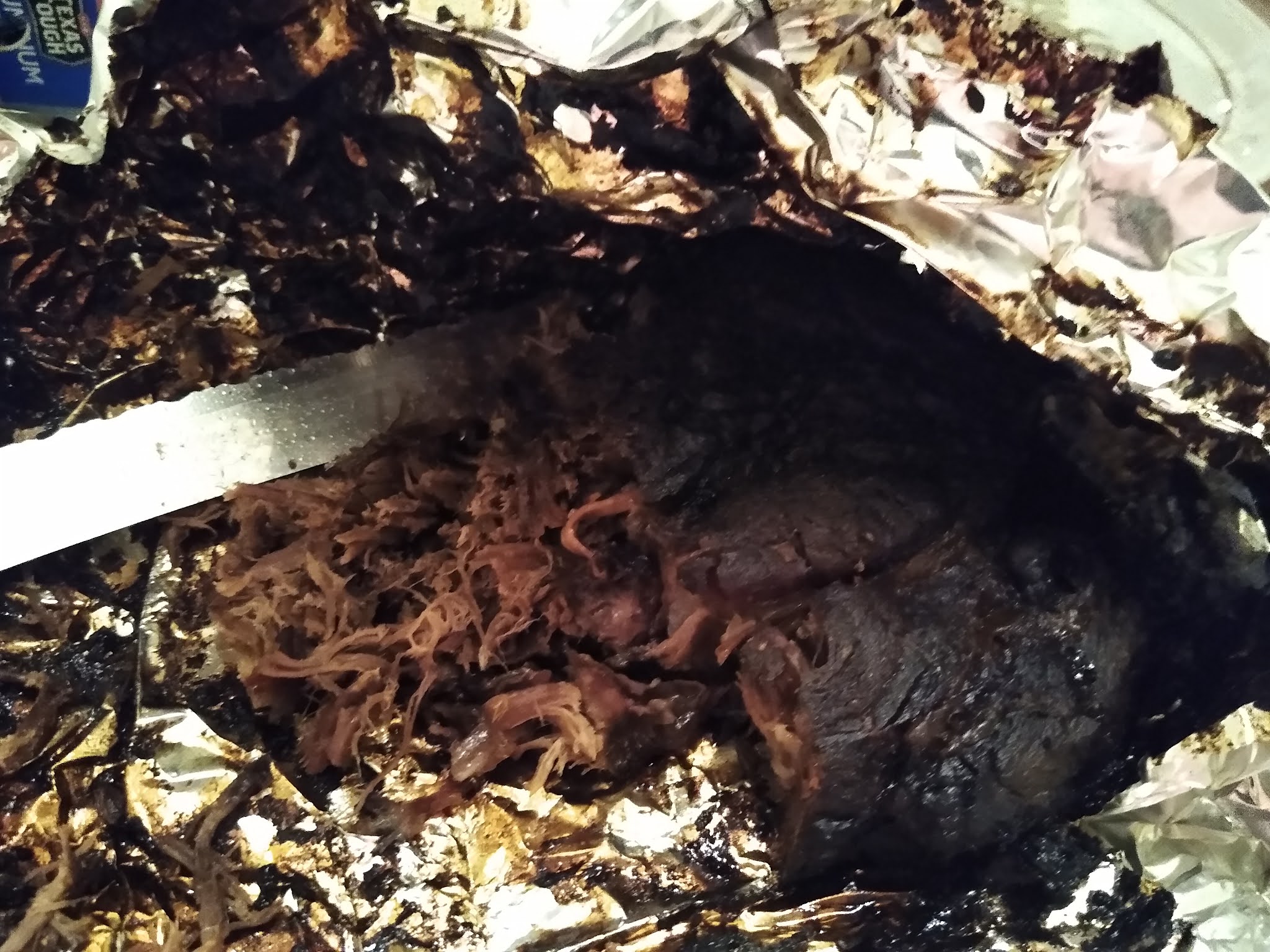
Apparently it's standard practice to let your meat rest for 15 minutes before cutting it. I thought it was just silly man-lore, but even Delia Smith tells us that we should. We therefore left both slabs in their foil for fifteen minutes, after which we unwrapped the first one and revealed cinders. Friends, there was sawdust when we tried to cut into it.


 Let's have a closer look at what we're not having for dinner.


Well, at least it has a good coat of bark on it.

If you picked out the not-burnt parts, they were dry and bland but not awful. At the very least, they were not over-smoked. With that said, no one was going to eat this. We cut it up to leave outside for the feral cats that we've been encouraging to move in for pest control, and got plan B out of the oven.


At this point, we haven't even unwrapped the second beef slab. I was tempted to throw it away in its intact foil wrapping and never speak of it again. But we decided we may as well saw it into pieces for the local wildlife. As the delicious smells of cheese and pepperoni filled the kitchen, we took a knife to the other beef cinder to reveal.... success.


I don't know why one beef slab turned out right but the other one dried up and died. But I'll take a 50% success rate over total failure.


Yes, there were still a lot of burnt parts to cut off, but there was a lot of delicious slow-smoked cow. These mixed results were promising enough that while I wanted to let any future efforts drop, everyone else was already planning what we will do differently next time. But for now, there was enough decent meat to make this a semi-success. Or at least, that is what I told myself to avoid realizing that I spent 8 hours slow-cooking cat food.

Saturday, March 27, 2021

Second-Stab Saturday: Successful sourdough bread!

 Ever done something out of spite?

One day a cutting board may enter my life.

What you're looking at is 100% whole-wheat, 100% sourdough bread. We didn't do any of that underhanded cheating where you add a packet of yeast to your dough for insurance (although it worked last time). Because I bake a lot and therefore try to tell myself that I'm good at it, I had a minor identity crisis when the two previous attempts at sourdough bread turned into bricks of failure. (Well, the second one didn't, but only because we dumped the aforementioned packet of yeast into it.)


Look at this jar, full of foamy lies!

We've been dutifully feeding this jar of glop for a while now, so now it's time to once again try to make it work. In the comments of our previous attempt, Lace Maker recommended this video, and we were sold on it for a few reasons. First (and I know this is daft), he is French and has the accent to prove it. Multiple people who've gone abroad say that the bread in France is so amazing that they can never again be happy with the bread back home. Of course, I don't know any of those people, but I've seen their posts about it in various travel articles. 

Anyway, let's check in on our starter! We are told to do the "float test." Supposedly, if a spoonful of your starter glop floats in water, it is lively enough to raise the bread. 

Well, crumbs.

We've gotten a few new tips out of his video, and my favorite is this new way to make a happy environment for your bread to rise. We used to just turn the oven to its lowest temperature, pop the bread in, and turn the oven off as soon as it heated up. That works very well (we've been doing it a long time). But to be a bit nitpicky, it dried the bread out a bit before it's had a chance to bake. 

To try this new (to us) way, we brought a pot of water to a hard boil and put it in the oven next to the bread. It fills the oven with cozy warmth without drying anything out. Of course if you're trying this at home, you'll want to fill the pot fairly high instead of just putting a bit of water in the bottom- that way, the pot has a lot more heat in it to slowly radiate out. You should also tell everyone not to turn on the oven without first emptying it.

Here we see the starter (set on a plate to catch any spill-out as it rises) in its nice incubation chamber.


After the starter got lively with foam, we tried the float test again. It didn't float. The starter dissolved as soon as it landed on the water. But we decided that our starter must be ready anyway because it was so full of life that it oozed right out of the jar and onto the spillover plate.


As you can see, this starter dissolved right into the water before it could pass any float test. Sorry, French person with a Youtube channel, I know my float-failing baking would break your grand-mère's heart. But we still hoped that this gravy-looking mixture of sourdough starter and water would make our bread rise without one of those newfangled yeast packets. (I should note that before proceeding, I made sure we had at least one yeast packet ready for emergency action.)


And now, while we try to make bread the historic way, let's have some actual history! When I started my first baking class, the teacher reverently read out the words "Bread in its simplest form consists of flour and water leavened by yeast," intoning them like they are the first sentence of Shakespeare's diary. That is not strictly true, the simplest breads have no yeast at all and are baked flat. Sourdough breads are the oldest leavened breads, but bread in its simplest form (contrary to the textbook) consists of just flour and water.


We should first note that most cultures around the world invented boiling, frying, and other stovetop cooking techniques before they invent baking- you need far less fuel than you would to heat an empty box long enough to bake something, and you food will be ready sooner. The history of bread follows this pattern. At first, we had porridge, because we discovered that grains get a lot easier to eat if you boil them soft. At some point, the mush was spread onto pan over a hot burner (or whatever the predecessor of a stove burner was) and became pancakes. Sourdough bread came naturally after that. If you leave flour-water paste out, yeast will move in. The very air around us is always full of floating yeastie-beasties, and apparently they like carbs as much as anyone who's ordered a third plate of spaghetti. So if you mix flour and water and just set it out, in a few days you will find that it's gotten rather bubbly. Or maybe it will just grow mold, but that's a rare enough occurrence that people started cultivating bread starters anyway.


Obviously, the first bakers came a few thousand years before we had microscopes to find just what is going on that makes bread rise, but they figured out most of the basics of baking anyway. They didn't know that yeast microbes existed, but they knew something was going in their bread dough, and they soon discovered that if you set aside bread dough to add to fresh flour, the new dough would rise faster (and was a lot less likely to get moldy instead of rising at all). They also discovered that the hot mash from beer-making made bread rise better (a few thousand years later, across the BC/AD divide in 1837, Miss Leslie still told people to obtain yeast from the local brewery in Directions for Cookery). People would also add things like grape skins to bread starter to make it work better. As later scientists would discover, grape skins (and plum skins) have thriving yeast colonies on them. 

Making sourdough bread is such a finicky process, it's no surprise that the Romans had a goddess of the oven. People baking bread the old way, back when it was the only way, needed someone to pray to lest their bread fail to rise and instead become a flour brick. Her name was Fornax. Her feast day, called Fornicalia, was February 17. But before we misrepresent baking as a primitive, unreliable process throughout history and up until 1925, you should know that bakeries in Herculaneum and Pompeii had commercial-scale flour-grinding, mixing and kneading machines, cranking out bread at least 80 loaves at a time (that's how many were in one oven when Vesuvius erupted). Just like many people today set a bread machine to the dough cycle, many bakeries did nothing by hand until it was time to shape the dough into loaves and rolls. Of course, the ancient machines were often powered by livestock or slaves, neither of whom ever get much credit for anything in history books.


A lot of the science of bread hasn't been discovering new methods. Instead, it's been using science to find out why we traditionally do extremely specific things to turn your flour into bread rather than clay.  What happens in a jar of flour and water that makes it foam with life if you leave it out in the open for a few days? What makes bread dough springy when you knead it, and why does kneading make your bread better? Why do we let the dough rise, flatten it back down, shape it into loaves, and let it rise again-- couldn't we save a few hours and skip the first rise? 

Speaking of letting bread rise, we must pause to appreciate the biggest shift science brought to bread. Long after US independence from Britain, after everyone in the world spent thousands of years of carefully keeping sourdough starters alive and patiently waiting for them to raise the bread, a marvelous innovation entered kitchens everywhere: yeast in little cubes (and later in powder packets). Sourdough bread, which for thousands of years had been the only way to make bread, experienced the same fate as candlelight, stick-shift cars, and vinyl records.  

Very soon after packet yeast, an absolute miracle came to everyone: white powders you could just add by the spoonful to make bread rise without any fuss at all! Or at least, early powders worked that well in theory. In practice, many of them either didn't work right or left chemical aftertastes. But we're getting ahead of ourselves, so let's step away from baking powder and its predecessors. Let's come back to using our microscopic friends to make bread.

Look, it expanded!


Speaking of traditional bread, you may think that round loaves are only for expensive bakeries that overuse the word "artisan." I know I did until I tried to shape the dough for myself. This oval shape is easier than making a long dough snake for baguettes.


Anyone trying sourdough at home soon finds out why packet yeast, that marvel of microbiology, usurped sourdough and became the "traditional" way to make bread. Making your own bread without modern yeast (or baking powder if you're daring) feels like doing my great-grandmother's recipes from Mexico. There's a lot of "You add more of this until it looks like that" and "keep mixing until it feels right" and "I don't know how long it should rest, you'll have to see if it's ready. You should be able to tell."  While scientists have given us a better understanding how breadmaking works, you should probably still pray to Fornax. I did, and our tight little ball of dough rose into this ready-to-bake, almost foamy-light ball of sticky success.

They say if you poke the side and it stays dented, the bread has risen enough to bake. I may have finger-stabbed it a bit too hard.
 

After all these days of carefully feeding the bread starter, after many hours of patiently waiting for the bread to rise, the baking time was so short it almost felt disrespectful. Nevertheless, the bread was done. We leapt forward a few thousand years in technology at the end of baking time, using a modern thermometer to ensure that the bread was thoroughly baked. Of course, we also used a modern thermostatically-controlled oven. My great-grandmother refused to follow her husband into the United States until he purchased her a stove that she didn't have to light a woodfire in, and we're not about to dishonor her today.


Depending on your attitude, this loaf is either cute, or it's rustic, or else it's severely plain. I could have cut decorative patterns into it for panache before leaving it to rise. But after so many sourdough failures, I was afraid it would collapse if I touched it more than strictly necessary. Plainness aside, this bread was absolutely delicious. 

I've heard people come back from France saying that the bread there is so much better than here. It turns out that if you hop onto the internet and find the nearest tutorial from someone in France, you too can have amazing bread at home. However, as adorably artisan as these traditional round loaves look, you will soon slice one and find that you can't make much of a sandwich on bread-fingers. You can, however, immerse them in soup.


The French may be fine with narrow bread slices. But here in America, bread is a vehicle for sandwiches more often than it is something you eat on its own. These bread slices were far too small to load with a whole lunch's worth of meat and vegetables. But by cutting one of these long bread-twigs in half, a decent (if unsatisfyingly small) grilled cheese can occur.

Someone else in the house thought these tiny single-egg frying pans would be nice. We've used them more than one would expect.


Because the plague has caused to me have more free time and less income, we're not using butter on this like some normal person would. Today's grilled cheese has been spread with ham fat, which we rendered while making soup stock out of the bones and stringy bits of the hams we bought on clearance after Thanksgiving. I had high hopes for this ham-and-grilled cheese, but you couldn't taste the ham-fat difference. It's a dang good grilled cheese though, even if it's so small you can put it on a tea saucer.


 With that said, I didn't want artistic bread. I wanted something you could make a sandwich on. I didn't care about making sandwich bread very much until I kept failing at it. So, with our next attempt, we made a loaf pan that seemed about the right size for the dough ball we had so patiently kneaded. If you're going to do this yourself, fold the foil first until you have several layers of it. Otherwise, your bread may push through the flimsy sides.

You can really see how much the bread knocked out the initially-upright "pan" sides if you upend the loaf.


But with that said, it tasted so good that it did not last nearly as long as an entire loaf of bread should. We all kept randomly cutting off a slice every time we passed through the kitchen. Even if one was just passing through to get to the next room, it was hard to do so without making a bread detour. And so, we at A Book of Cookrye highly recommend trying sourdough if you like bread and have a bit of free time on your hands. It may not come out well on your first attempt (or three), but the ingredients are just flour and water. So it's not like you're out the price of an expensive beef cut or something like that every time your bread comes out lousy. And if you persist, you can have one of these in your own kitchen!