Showing posts with label Dormeyer cookbook. Show all posts

Sunday, November 16, 2025

Escalloped Corn

Did you know that Chicago is by definition Midwestern?

Escalloped Corn
2 cups canned corn, drained*
1 tbsp butter
2 tbsp flour
1 cup milk
1¼ tsp salt
Chili powder, black pepper, paprika, and other seasonings to taste
2 eggs, separated
¼ cup diced ham
½ cup shredded cheddar cheese (mild or sharp, whichever you like)

Heat oven to 350°. Grease or spray a medium casserole dish.
Melt butter, add flour and mix well. Slowly add the milk, stirring hard as you pour it in. Cook until it comes to a boil, stirring constantly. Reduce heat to medium and cook 2 minutes longer, scraping the pot the whole time. Pour into a large mixing bowl. Mix in corn, seasonings, ham, and egg yolks.
Beat egg whites until stiff peaks form, then fold into corn mixture.
Pour into the pan. Sprinkle .the cheese on top. Bake until the cheese is golden brown, about 30 minutes.

*Use a 16-oz can, or whatever happens to be the closest size on the grocery shelf.

All Electric-Mix Recipes Prepared Specially for your Dormeyer Mixer, 1946

ESCALLOPED CORN 
2 cups corn 
1 tbsp. butter 
2 tbsp. flour 
1 cup milk 
1¼ tsp. salt 
1 tsp. sugar 
Dash pepper 
2 eggs 
¼ cup diced ham 
½ cup diced American cheese 
Method (with DORMEYER mixer) 
Melt butter, add flour and mix well. Add milk and cook until it comes to a boil, stir constantly, cook 2 minutes longer. Add corn, seasonings, ham and cheese. Beat egg yolks 1 minute at medium speed. Beat egg yolks 1 minute at medium speed. Beat egg whites 2 minutes until stiff, use high speed. Fold egg yolks and whites together, then fold into corn mixture. Place in a buttered baking dish and bake 30 minutes at 350 degrees. Serves 5 or 6.
All Electric-Mix Recipes Prepared Specially for you Dormeyer Mixer, 1946


Today, we are revisiting the Dormeyer mixer recipe book. Mom found it at an antique store for 80¢ when I was tiny. I didn't know at the time that old advertising handouts are so common that most antique stores have racks of them for less than the cost of a candy bar. Therefore, I thought it was it was a special compilation of recipes that were all old enough to be heirlooms by now. So it felt like getting a lot of lovingly passed-down recipes without having to wait for multiple generations of relatives to pass them down. (Because I didn't know about low-quality paper, the book's brittle, browned state made it a rarer treasure.)

Getting to the recipe, today we are making something called "escalloped corn." I guess that tacking an extra "e" onto the word "scalloped" makes it extra fancy? 

This is one of the few recipes that doesn't have any brands in the ingredients. The writers credit "our own Dormeyer kitchens" for the few recipes that didn't come from any food companies. There were no Dormeyer kitchens. They just had their employees send in recipes to round out the book. Given that Illinois has a lot of corn fields once you drive out of Dormeyer's hometown of Chicago, I'm not surprised that we have a corn casserole.

As we soon found out, "escalloping" our corn starts with white sauce.


I'm not going to make any snipes at Midwestern recipes and their apparent aversion to spices. But I will note that I added a truly uncalled-for amount of chili powder.


I know that most casseroles look terrible in the mixing bowl, but this one looked particularly bad.


And now we get to the only reason our escalloped corn is in a mixer instruction book: whipped eggs. I wonder if the Dormeyer people included this recipe subtly promote the extra beaters (sold separately). You can't whip egg whites if you get a single errant drop of yolk in them. Therefore, you have to either pause the recipe to wash the beaters, or get out out a second mixer.

This is a lot of bowls for canned corn.

On a more general note, I really don't think this recipe would exist without mixers. I can't imagine anyone wearing out their wrists to beat egg whites for canned corn, escalloped or not. Even a hand-cranked eggbeater is too much work for canned corn.


Our casserole looked particularly vomitous in the pan. This is why we always cover our casseroles with cheese. (Also, I didn't see the direction to stir the cheese into everything else.)


After seeing how ugly this looked, I was ready to say a lot of mean things about it. Then I tasted a spoonful and instantly stopped regretting that I preheated the oven for this.


But even though I have a dishwasher and multiple electric mixers (they turn up cheap at thrift shops), I didn't like how many dirty dishes were involved in making a casserole. Aren't you supposed to just put everything into a big pan and bake it?

So, when I escalloped some corn again (yes, this was good enough to make again), I reduced our beater count by 50% and dumped the egg yolks into the with everything else. Then I buried the whole mess under seasonings that never made the Dormeyer print edition.


If the goal of this recipe was to achieve greater volume and height, skipping half the steps works better than following the directions. The corn mixture still looks like barf, but now it's extra-fluffy barf.


I liked everything about this recipe except its airiness. Even though it was fully baked, it had the texture of an uncooked mousse-- with canned corn in it. 


But with that said, this tasted really good. I don't think you can go wrong with ham, corn, and cheese. The leftovers were a lot better after firming up in the refrigerator overnight. So even though the Dormeyer people wanted to demonstrate the versatility of electric mixers with corn casserole ("It's not just for cakes!"), this is almost certainly better if you just stir it together and put cheese on top.

Sunday, November 2, 2025

Cranberry Ice Cream

Millions of people in the US are about to lose food benefits. If you are considering buying groceries to drop off at your local food bank, think about donating money directly to them instead. Food banks often buy food at bulk rates, so your money will feed more people than if you did the shopping yourself. And of course, the people in charge of food banks have a firsthand view of what foods are needed. 

Right, on with the cranberries...

Autumn is here, even if the weather doesn't think so yet. Nevertheless, it is now socially acceptable (ish) to buy large quantities of cranberry sauce.

Cranberry Ice Cream
1 can jellied cranberry sauce
1 cup heavy cream

Put the cranberry sauce in a large mixing bowl that will fit in your freezer. Beat with an electric mixer until smooth.
In a separate bowl, whip the cream (no need to rinse the cranberry sauce off the mixer beaters). Fold the cream into the cranberry sauce.
Place in the freezer. Freeze the beaters alongside it. When almost frozen solid, beat again with the mixer. It will deflate at first, but then re-whip. (This second beating makes it creamier.) Transfer to your storage container of choice and freeze until firm.

Adapted from All Electric-Mix Recipes Prepared Specially for your Dormeyer Mixer, 1946

CRANBERRY SHERBET 
1½ cups cranberry jelly 
1 cup heavy cream 
Grated rind of 1 lemon 
Juice of 1 lemon 
Juice of 1 orange 
Method (with DORMEYER mixer) 
Place jelly and fruit juice in DORMEYER small mixing bowl and beat with DORMEYER mixer at slow speed for 2 minutes. Whip cream 2 minutes at high speed until thick. Fold cream into jelly mixture. Place in tray and freeze until almost firm, remove from tray, place in chilled bowl and beat 2 minutes at medium speed, return to freezer and finish freezing. Serves 7.

When I bought the fresh produce for this recipe, I couldn't help noticing the country of origin on those little stickers. None of the fruits came from within US borders. Unless a certain special someone stops playing at tariffs like they're fantasy football, a lot of people will end up making severe cuts to the impending holiday season menu.


After our initial prep work, we now have fruit juice and a big red can! 

Incidentally, a lot of people think of canned cranberry sauce as more of a centerpiece than something you eat. Many Thanksgiving tables are incomplete without the can-shaped cranberry-- even if no one eats it. From what I gather, it is a charming callback to the the "better living through chemistry" era of cooking. But I like to actually eat the stuff, so I was excited to find a new way to use it.


After beating the jelly as smooth as it would get, I tasted some and immediately regretted adding the citrus. Maybe it would improve with freezing, but at this point it was bitter and sour. Then the fruit juice separated out while I whipped the cream. It's never a good sign when your ingredients form puddles.


Well, just a few minutes after I started the mixer, our sherbet was ready to freeze! It certainly looks like I put nearly no effort in, doesn't it?


Our half-frozen sherbet deflated as soon as I had at it with the mixer. I was going to throw it out, but I figured there was nothing wrong with beating longer to see what happened. After all, you can't ruin what's already ruined. To my surprise, our sherbet gradually reinflated. 

After I tasted this, I only finished the recipe to see if the method worked. Our sherbet was powdery. It wasn't agreeably grainy like water ice or a sorbet, but oddly dry. Maybe the citrus curdled the cream? Either way, this was a sad waste of canned cranberry sauce.

I threw everything out. However, this recipe had potential, so I made it again without any fruit juice. Things looked promising as soon as I turned on the mixer. The cranberry sauce turned into this lovely, smooth glop instead of chunklets in a watery mess.


Because we didn't have to fuss with a lemon squeezer, we had this in the freezer in minutes. Just to see if it really needs to be beaten twice, I spooned some into a little bowl to freeze alongside it. The mixture tasted delicious, but you can see that it had the same sort of little curds that ruined the first batch. It didn't have the same weird texture, so I was optimistic.


After freezing it once, the ice cream wasn't bad. But it was a lot creamier after following the directions and beating it twice. True, it wasn't as nice as if I had used an actual ice cream machine (I don't think freezer ice creams ever are). But if you don't want to mess with crushed ice and rock salt, this is pretty good. I didn't throw any of it away, nor am I chucking out the recipe.


This has to be one of the few times when crossing out most of the ingredients actually made something better. Usually those "two-ingredient [whatever]" recipes are terrible, but this was so good I made it again.

Saturday, June 15, 2024

Second-Stab Saturday: More Dormeyer Cheesecake

I love when I can simultaneously clean the freezer and make dessert.

Cheese Pie Royale
1 pie pan lined with a graham cracker crust
12 oz cream cheese, at room temperature
2 eggs
½ tsp vanilla
½ cup sugar
Cinnamon

Topping:
¾ pint (1½ cups) sour cream
2 tbsp sugar
½ tsp vanilla

Heat oven to 375°.
Thoroughly beat eggs and sugar. Add cream cheese, and beat at low or medium speed until mixed.
Pour into pie pan, leaving about ⅜" of headspace in the pie pan for the topping. Sprinkle with cinnamon, and bake for about 20 minutes, or until the cheesecake jiggles in the center but does not slosh.
While the pie is baking, whisk the topping ingredients together. Spread it over the pie after it's baked. Heat oven to 475°. Return the pie to the oven and bake 5 minutes.
Cool the pie, and then refrigerate it until thoroughly chilled.

Source: All Electric-Mix Recipes Prepared Specially for your Dormeyer Mixer, 1946

After making the poppyseed cake, we had half a brick of cream cheese in the freezer. I didn't know what to do with it, but I also didn't want to let it go to waste. I decided I could use it to revisit a recipe that didn't get a fair chance last time: the Dormeyer cheesecake. Some readers may recall that due to a faulty oven, we burned it. And burning a cheesecake isn't a valid recipe test. 

Since we had all the ingredients at hand, I cut the recipe amounts down to the tiny pie pan's worth of cream cheese that had been waiting in the freezer.  Then, while supper was already baking, I slid this into the oven next to it.


Unlike the first time we tried this cheesecake, we didn't burn it. (I do love using an oven with a working thermostat.) The non-burnt Dormeyer cheesecake looked so pretty that I wished I'd bought enough cream cheese to make a full-sized one. (I later realized I forgot the cinnamon, but it was too late.)


I really wanted to try the sour cream topping that came with the recipe. I've never had a cheesecake with sour cream on top. Given that the Dormeyer company comes from Chicago, is this a Chicago thing? The recipe handout credits every recipe that doesn't have a brand name to Dormeyer's own test kitchens, which apparently means they had people in the company office send in recipes to round out the book. So maybe there are some Chicago regional specialties between the other recipes.


After baking, the sour cream on top of our cheesecake wasn't completely set, but it was at least firm enough not to drip. The cheesecake itself looked oddly... aerated. Is it just me, or does it almost look like a slice of well-leavened cake?


If we turn the cheesecake around and look at where the crust would have been had I bothered to make one, you can see the texture better. I think it looks like I added a lot of baking powder to it.


The cheesecake tasted fine, but the texture was weird. It was almost but not quite curdled. Perhaps a better way to describe it is "aggressively fluffy." I have to wonder if this is a regional preference, and the people of the greater Chicago area think this is what cheesecake should be like.

But while the cheesecake itself was a bit underwhelming, the batter was amazing. I wouldn't toss the recipe aside, but I wouldn't bake it either. It's probably fantastic if you put pour the batter into an ice cream machine. To the Dormeyer people's credit, the part of this recipe that involved using a Dormeyer mixer went great. But the part that involved an oven did not.

Tuesday, February 20, 2018

Lots of cakes: or, A Book of Cookrye experiments on friends!

As has been somewhat frequently mentioned, we at A Book of Cookrye are now in cooking school, trying to eventually get paid to do something we like. In baking class, we've spent a lot of time (obviously) making cakes. This has come with a lot of lecturing on the chemistry of cakes, and so much physics I almost expect to see Greek letters appear on math formulas again. Much use has been made of phrases like "incorporating air cells," "activating gluten," "coagulating egg proteins," and "emulsifying fats."
Which brings us to mixing a cake! Did you know how many fascinating physics are happening in your mixing bowl (all of which I had to memorize for a test)? Did you know how many ways there are to mix the a cake? Multiple methods were mentioned in class (there are practically as many different ways to mix a cake as there are cake recipes floating around online), but we in class only looked at a  four.
"It makes such a difference!" the teacher insisted. "If you don't believe me, go home and try them all at on the same recipe!"
We at A Book of Cookrye were very skeptical indeed. How much difference can it make unless you do something wrong like overbeat it until the flour toughens up everything? Therefore, because it involved a lot of cake and also a lot of experimenting, we were more than willing to test this.
However, if you're going to try four cake-mixing methods, you will end up with four cakes. As we no longer live in a dorm with people to give baked goods away to, what would we do with four cakes? We then got invited to a friend's house party. Which brings us to today's recipe:
All Electric-Mix Recipes Prepared Specially for your Dormeyer Mixer, 1946

We've run this recipe before. Since know how it comes out when you make it as the directions tell you to, it seemed as good a choice as any. Also, it tastes good, so the prospect of having four of them threatening the counterspace and my recently-successful dieting isn't at all dreadful.
Well, let's start the method trials with...

THE CREAMING METHOD
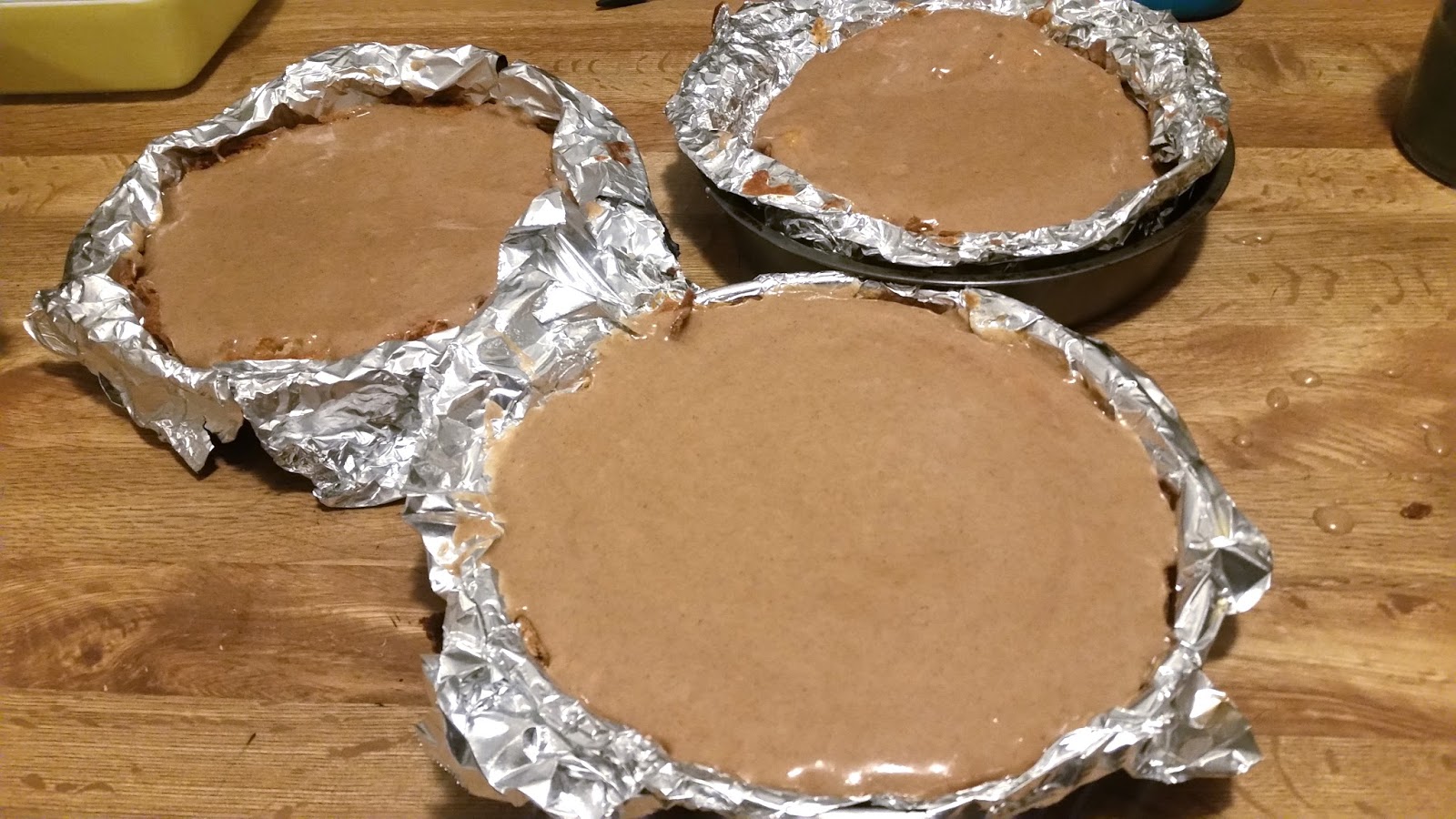
Notice the foil condom on the pan because we have a lot of cakes coming up and no dishwasher.

This one comes up the most often in cake recipes. You know, the recipes where the directions read something like "Cream butter and sugar, then beat in the eggs. When all is mixed, alternately add the flour and milk, beating just until mixed..."
We started to see compelling evidence that changing the mixing method would make a lot more of a difference than we suspected. The batter was a lot thicker than when we made it using the original recipe directions, which looked like this:

Not that the original recipe is watery-thin, but changing the mixing directions made a batter that almost did not want to spread into the pan.
While that was baking, we proceeded to...

THE FLOUR-BATTER METHOD
Apparently this produces a really good pound cake. What you basically do is mix the butter with half the flour. Then you beat the eggs and sugar until they're good and foamy, and then put the whole thing together. In class, they admitted that "This way is really old-fashioned, you don't really see it anymore." Old-fashioned? Rarely used? Of course we're going to try it!

As you can see, while the creaming-method batter was already thicker than the original recipe, this made a little mountain in the pan.

When you make the same cake over and over again in one day, you eventually stop needing to look at the recipe. If I had a dishwasher, I might have measured out all the ingredients for each cake ahead of time because I got really tired of having to do it repeatedly. But who wants to hand-wash all those storage tubs? Well, let's move right on ahead to...

THE MERINGUE-BATTER METHOD
We've actually posted a cake made like this before. Basically, you mix the flour and the butter together until it looks like you're making a pie crust. Then you add the egg yolks (if the recipe uses whole eggs), forcing them to mix into the crumbly stuff in the bowl. After that, you make a meringue out of the egg whites and the sugar, and mix that into your flour clods. Congratulations! You have a cake!

Well, that method was a lot of fuss and bother. And after having to get out so many bowls for separately beating eggs, separately combining some of the ingredients before adding them to something else, and so on, I asked myself, "Can we do this with less dishes?"
It turns out, we can! Let's move on to the one I really was looking forward to...

THE FUCK-IT METHOD
Put everything in the bowl and insert an electric mixer. If you hate having to make an effort, this will feel great.
They gave this method a nicer-sounding name in class, but I'd rather call it for what you're probably saying as you dump everything in.

We were warned that this is not the best method for cake mixing and that you have less control over the batter. The phrase "improper incorporation of air cells" was deployed. But how much difference could it really make?
I don't know where that metal plate came from, but I was very glad to find it when I looked in the oven and saw that the fuck-it cake was dripping all over the oven.

Apparently it makes a lot of difference.
Incidentally: note the planning ahead in moving the cake that was already in there to the front when adding the next one since it would theoretically come out of the oven first.

After hastily jamming the aforementioned metal plate under it, we intended to finish baking it just to see what would happen. However, it kept gushing out of the pan. You'd think eventually there'd be no more batter to spill out, but this kept oozing over, dripping out astonishingly foamy splurts.

It turns out that cake batter makes an incredibly strong adhesive, seeping under the foil to glue it to the pan, and then gluing the pan to the plate that was supposed to catch the batter drippings. You could hold it upside-down and nothing fell.

Well, let's have a look at the three survivors.

The meringue cake had this ever-so-slightly shiny top crust, the flour-batter cake was really spongy and was most likely to bend with the foil when you pulled it out of the pan rather than hold its shape, and the creaming-method cake looks... like cake.
You can really see the top crust of the meringue-cake here. It looks kind of like that top layer you get on brownies.

Before taking these cakes out in public, we decided to spend about 45 seconds stirring together a big batch of cinnamon icing, which we then dumped on all three.

And so, I brought all three cakes to my friend's house party.
Incidentally, the really great thing about lining the pans with foil (aside from not having to wash them) is that once you've arrived to wherever you were going and set the cakes down on the table, you can lift them out of the pans, stash the pans in your car, and not have to worry about forgetting them or anyone scratching them.
But what did everyone think of these? After explaining what was on trial here, I asked my friends what they thought of the cakes. Could they tell the difference? Why, yes they could!
 There wasn't much difference in taste, but as the group photo of uniced cakes suggests, they had very different textures. While everyone liked all of them, the creaming-method cake was least popular (though substantial portions of all three disappeared from the pans). The flour-batter cake was slightly drier than the creamed cake, but also lighter. The meringue-batter cake was the most popular, if we measure popularity by how much cake was missing from the pan afterward.
To my own surprise, it appears that not only does changing how you mix a cake give you a different texture, it can actually change the taste. No one specifically noted a flavor difference in the cakes, but a lot of people thought I had put sweeter icing on the flour-batter cake. Since the icing on all three was from the same big batch, that must mean the cake underneath it tasted different.
And so, I am very glad I had kept my skeptical pooh-poohing to myself in class. It turns out the teacher was right.

Saturday, October 14, 2017

Lemon Meringue Cake: or, The egg whites were sitting in the freezer anyway

Do you refuse to throw away perfectly good ingredients even if you have no idea what you'd use them for? Do you have nearly full sauce bottles lurking in your cabinets because you made a recipe that called for one tablespoon of something you haven't used since? Are there frozen scraps of this or that carefully wrapped in your freezer because you might find a use for them someday?
If so, we at A Book of Cookrye are no better than you. More than anything, we have a lot of egg whites in the freezer from making a lot of recipes that called for yolks. Of course, one can more easily find recipes for egg whites than one might find one that uses, say, asafoetida or those last meat scraps that you bagged up instead of throwing out.Today, our friends at the Dormeyer electric mixer factory have a super nifty idea for us:
All Electric-Mix Recipes Prepared Specially for your Dormeyer Mixer, 1946

Lemon Meringue Cake
Lemon cake from the recipe of your choice*
2 egg whites
Dash of salt
½ c sugar
¼ tsp lemon extract

Bake the lemon cake in a 9x13 pan.
After removing it from the oven, beat the egg whites and salt until foamy. Gradually add the sugar, beating constantly, until it stands in stiff peaks. Add the lemon extract.
Spread over the cake and bake 10 minutes.

*The original recipe is the Mix-Easy Two-Egg Cake with 2 tsp lemon rind added to the butter or shortening. For the record, I used this recipe instead because it calls not for 2 eggs but 5 egg whites, and I have an embarrassing number of egg whites in the refrigerator.

All Electric-Mix Recipes Prepared Specially for your Dormeyer Mixer, 1946

Does a lemon meringue cake seem like a desperate reach for novelty to anyone else?  I guess there are only so many cake recipes you can come up with before you reach the end of cake. This is especially true of an advertising pamphlet, which (unlike a more serious cookbook) tends to avoid what one may call the more adventurous recipes. Having said that, our friends at the Dormeyer company decided to run some 50-odd cake recipes in their advertising pamphlet. When the you barely allow any flavors in your cake chapter that one wouldn't find in the shake machine at a drive-thru, some possibly misguided creativity will ensue.

I can just imagine the people in their desks under orders to come up with enough cake recipes to fill 20 small-print double-sided pages. Eventually someone decides to take the pie out from under a lemon meringue pie and put a cake in there instead. As a bonus, meringues are a great excuse to justify selling electric mixers because beating egg whites into shaving cream by hand sucks.
Note the deployment of foil to forestall washing.

I couldn't get over how weird it is to put meringue on a cake. In my limited cooking experience, meringue has only appeared two places: on top of pies, or made into cookies. Putting meringue on cake is utter madness. What topsy-turvy world is this?

The cake looked actually rather nice right out of the oven. It is a really enticing-looking big pan of meringue once you get over the fact that this clearly is not a pie.
 
However, as seems to often happen to meringues here at A Book of Cookrye, it sweated out little brown beads as it cooled.
Do you think they look enough like sprinkles that I could claim I did it on purpose?

Apparently whoever thought of a lemon meringue cake was afraid to really stick to the premise- that is a puny ration of meringue for a cake this size. If you look at any slice of lemon meringue pie, the meringue tends to be at least as tall as the lemon under it. But having followed the recipe instructions, this is how much meringue, er, crowned the finished creation.

That is a pathetic layer of icing, isn't it? If you ate a slice with your eyes closed, you couldn't even tell the meringue was there. I mean, it will help keep the cake from going stale the same way any icing does. So if you never really liked the taste of icing on cake but still think a bare cake looks kinda ugly, this idea is for you.

Saturday, July 1, 2017

Second-Stab Saturday: I really wanted blender cake to work

You know that zucchini bread we did in a blender in an attempt to get as much use as we can out of a wedding present? Its sad, gummy failure weighed heavily on my mind. Was it the blender's fault? Or was it the choice to use zucchinis in it? There was only one way to find out, and it involved more cake.
Nothing like a big blender of sugar and fat to start the cooking day!

For reference, we're making this cake recipe since we know it works when made like a normal person would.

Mix-Easy Two-Egg Blender Cake
½ c shortening or butter
1½ c sugar
2 eggs
2½ tsp baking powder
` 1 tsp vanilla
1 tsp salt
1 c milk*
2¼ c cake flour (I used all-purpose flour and removed 2 tablespoons)

Heat oven to 375. Grease and flour cake pans (this cake is prone to sticking to the pan, so you want to also dust it with flour to be sure it comes out).
When using a blender, stop the motor after each step to prevent overbeating.
Put shortening, sugar, and eggs in blender. Thoroughly mix, stopping the motor to scrape the sides of the pitcher as needed. Add the milk, blend thoroughly. Then drop in the vanilla, salt, and baking powder. Blend until all the lumps disappear. Stop the machine if you haven't already, and add the flour all at once. Blend it in on the lowest speed the blender has, turning it off as soon as it is mixed.
Pour into pan(s), poke out any large bubbles that rise up, and bake for about 20 minutes for cupcakes, 25 minutes for layers, or 35 minutes for a sheet cake.
 
*With butter, margarine, or lard, reduce milk by 2 tbsp.

adapted from All-Electric Recipes Prepared Specially for your Dormeyer Mixer, 1946

And so, not knowing whether to be hopeful or not, we started the motor! Isn't that a pretty butter rosette?

You may have noticed the sugar on the edges of the pitcher was reluctant to blend in. However, I am quite capable of staring at the blender and waiting until, without warning, everything suddenly gets really runny.

Here I began to lose faith in ever making a blender cake. I've never had cake batter look this watery so early on. Had I irreversibly messed up the cake already?

As anyone familiar with Book of Cookrye philosophy can attest, we do not throw away failures. We expend more and more ingredients trying to salvage them until at last we have something that's almost good enough to eat. Then, having used more groceries than we would have had we thrown out the initial failure and started over, we eat our mediocre creation and try to feel better at having avoided waste. With that in mind, it should be quite obvious why, instead of sampling common sense on a trial basis, we dumped in the milk and proceeded with the recipe. An unexpected bright side of using a blender: when one is being cheap and using powdered milk, there is absolutely no way any powder clumps can survive.


We now had what looked and tasted like a blender of melted ice cream. It even had the exact same thickness. This may get dumped into the ice cream maker instead of mixed with flour and baked. Incidentally, adding all the flour didn't make as much of a visible difference as I thought. You know how cake batter tends to get thicker once you add flour? You could barely tell.
Though I have to say, the flour was mixed in seconds.

I considered making this into a layer cake, but just like last time, making cupcakes gets a lot more enticing when you don't have to keep dipping a little cup in the batter and then having said cup drip everywhere while you pour the batter out.
The cupcakes rose promisingly in the oven, but after seeing the zucchini muffins do the exact same and then deflate to zucchini paste, I remained wary of prematurely declaring triumph.

Just like last time, they looked puffy and perfect when first removed from the oven. But would they stay that way?

Indeed they did! Just as all cakes should, these looked exactly the same right out of the oven as they did after they cooled.

And how did they look in the middle? They looked perfect, that's what.


So yes, you can make cakes in a blender! They'll actually come out really good! As a bonus, absolutely nothing will splash all over the counter when mixing since you've got a lid on the blender. But don't take my word for it, get out a blender and try it yourself!