Showing posts with label soup. Show all posts

Tuesday, February 10, 2026

Roast Pumpkin Soup: or, Carrots can't be everything

Today, we are making more Delia recipes!

Roasted Pumpkin Soup with Melted Cheese
1 3-3½ pound whole pumpkin
1 tablespoon peanut oil
1 large onion, finely chopped
3 cups vegetable or chicken stock
2 cups minus 2 tablespoons whole milk
2 tbsp butter
Nutmeg to taste
4 oz Swiss cheese (Gruyere or Fontina), cut into ¼-inch cubes (or any other cheese that melts well)
6 tbsp cream or creme fraiche
Fresh parsley (dried will do in a pinch)
Croutons
Salt and pepper to taste

Before beginning, take the cheese out of the refrigerator so it'll be at room temperature by the time you serve it.
Heat oven to 475° (gas mark 9, 240°C).
Cut the pumpkin in half from top to bottom (ie, from the stem to the blossom end). Quarter each section lengthwise (so you have eight pumpkin slices). Scoop out the seeds and string. Brush with oil, shake on salt and pepper to taste, place on a heavy baking sheet (thin ones will warp), and bake until fork-tender, 25-30 minutes.
While the pumpkin bakes, melt the butter in a large pot over high heat. Cook the onion until it just begins to turn color. Reduce heat to low and cook, stirring occasionally, for around 20 minutes.
When the pumpkin is done, remove from the oven and let cool. Then scoop the "meat" off the rind and add it to the pot. Add the milk and stock, then salt pepper and nutmeg to taste. Simmer for 15-20 minutes.
Then blenderize the soup. (Unless you have a large blender, you'll want to do this in batches.) Leave the center cap of your blender lid open (or whatever sort of opening the blender has at the top to allow you to pour in things while it's running). For reasons I don't understand, when you turn a blender full of very hot liquid, it suddenly pressurizes enough to pop off the lid and splatter everywhere. Leaving the lid a little open prevents that, just like loosening the lid on a container of leftovers before putting it in the microwave.
Pour the soup through a strainer to catch any stringy bits that the blender missed.
At serving time, heat the soup to a very low barely-simmer. Stir in the cheese cubes until they's warmed through and barely starting to melt. You don't want to melt the cheese. This soup is so much better with the soft cheese floating through it.
Ladle the soup into bowls (preferably warmed). Spoon a little cream into each one. Sprinkle with croutons and parsley.

Delia Smith's Winter Collection, 1995

I've said this before, but I really love watching Delia Smith videos. She manages to give very precise directions, but somehow comes off as calming instead of nitpicky. It is a rare skill, which I think is a big part of why her career has lasted so long. 

A lot of her ingredient lists involve things that are special-order items on this side of the Atlantic (even when there isn't an ill-advised trade war on), but this one looked easy to shop for. However, I didn't want to use a pumpkin. For one thing, you can't get a fresh pumpkin in midwinter without nicking someone's leftover porch decorations. Also, I didn't want to dull my knife by hacking through a raw squash. So instead, we're using... these!


To my surprise, our carrots actually took a little longer than a pumpkin would have. But they smelled unexpectedly good toward the end of their roasting time. To emphasize: Delia Smith is so good that she can make carrots enticing, and she didn't even use carrots in this recipe.

Moving away from carrots and onto happier ingredients, I doubled the onion in the recipe. It doesn't look like a lot because we halved the soup. But you can take my word that we are being wonderfully generous with the onions.

Here we get to the first reason to use an actual pumpkin instead of carrots. Had we used pumpkin, the rind would have been charred but the edible part would have been fine. Since we didn't follow the recipe, we had to cut the blackened underside off of each carrot before putting it in the pot. (The second reason to use pumpkin is that carrot soup just isn't as nice.)  


Now that the pot was fully loaded, we could get to the toppings. I had cut up some French bread to make our own croutons, and slid them in the oven under the carrots. You shouldn't make croutons at nearly 500 degrees, but I thought it preposterous to get out the toaster when the oven was already fiendishly hot. 

I'd love to say they came out perfect, and they were indeed just the right shade of golden on top. But when we flipped one over, they were a little well done. Fortunately, they weren't completely burnt. If you like dark toast, they'd be fine.


At this point, we only needed to simmer and wait. Unfortunately, I forgot to make extra croutons to snack on while the soup cooked. I've said this before, but I really like croutons. When I let myself buy them, I eat them right out of the box the way other people go through potato chips.

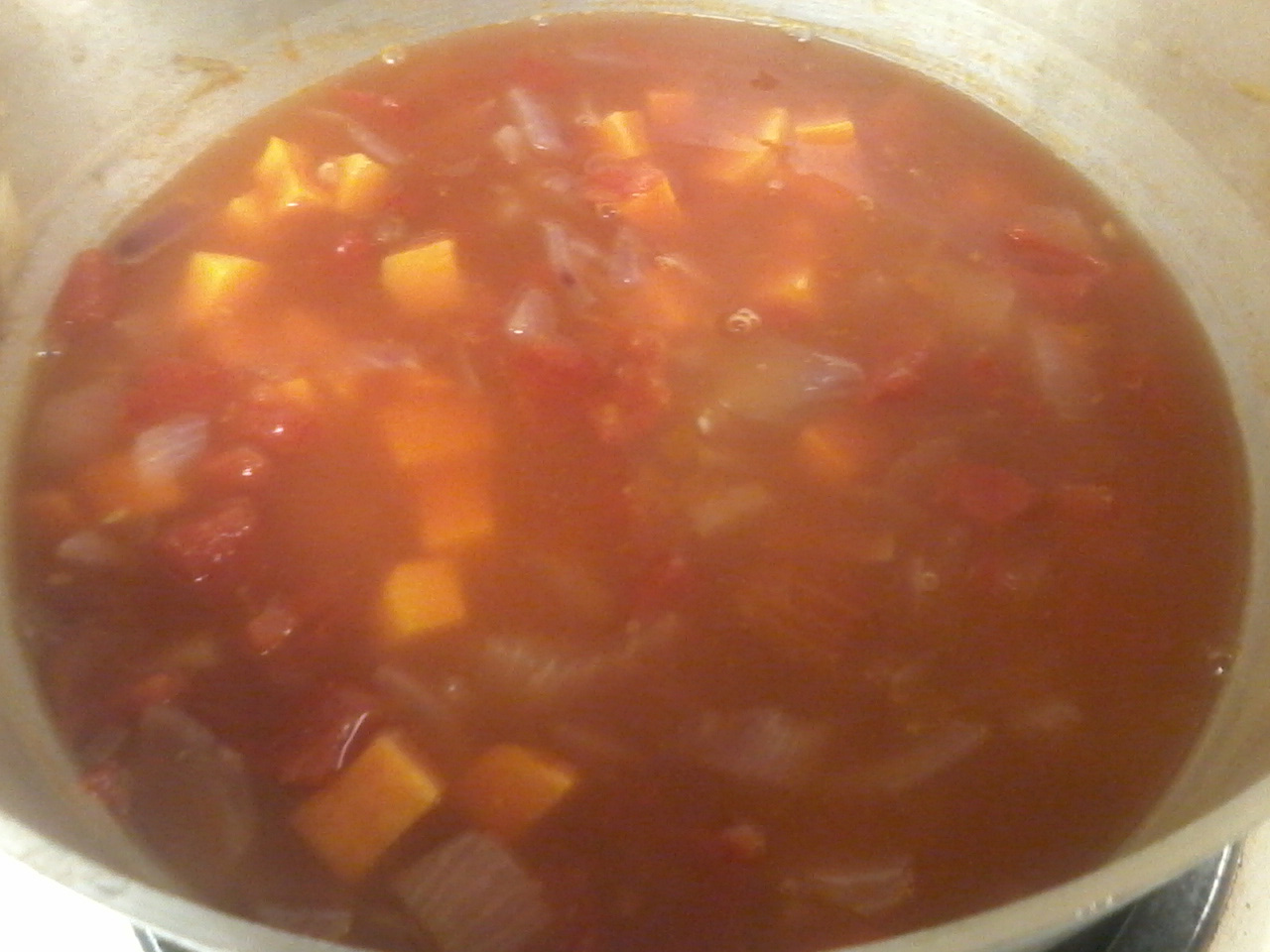
The carrots plumped up a bit, but they didn't look great.

The blender made things look worse. Had this soup got any more unsightly, I could have passed it off as a diet recipe.


I forgot that carrots tend to cook to a brighter color than pumpkins. Our "pumpkin" soup looked like a safety warning sign. Maybe that's another reason to follow the recipe and use pumpkin: no one wants their soup to look like melted crayons.

This reminds me: a lot of the bigger Crayola boxes have a color called "macaroni and cheese."

All right, so our soup is kind of ugly. But let's dress it up with everything the recipe calls for:


That looks so much nicer, doesn't it? I know sprinkling on dried parsley lacks the panache of garnishing with fresh, but it still adds a nice flavor.

This soup was sweeter than I thought it'd be. But then again, it had roasted carrots and half-caramelized onions, so should I be surprised? The nutmeg added a bit of a sausage-y overtone which I thought was really nice. And of course, the half-melted cheese interspersed throughout was amazing. I would have liked provolone better, but that's just because I really, really like provolone.

For the record, carrots make a perfect counterfeit pumpkin pie, but they do not make a similarly magical pumpkin soup. This was good enough to save the leftovers, but I won't use carrots for this again. If I can get my hands on an actual cooking pumpkin (and perhaps a Sawzall with food-grade blades) I will revisit this recipe.

Tuesday, February 11, 2025

Onion Soup Gratinee: or, Every bit as good as I hoped

"Oh, go eat a boiled onion!"

Onion Soup Gratinee
3 white or yellow onions
3 tbsp butter or margarine (or cooking oil if desired)
6 cups beef stock
1 clove garlic, chopped (if desired)
2 tbsp chopped parsley (fresh or dried)
Salt and pepper to taste
3 tbsp grated cheese (we recommend provolone)
¼ loaf French bread, sliced to desired thickness

Have a large casserole dish ready.
Quarter the onions lengthwise and slice thinly.
Melt the butter in a soup pot. Add the onions and cook until slightly golden. This will take a while, so have patience. If using butter, be sure to stir it often or else it will burn onto the bottom of the pot.
Add beef stock and bring to a boil. Reduce heat and simmer 10 minutes.
While the pot is simmering, put the bread slices onto the bare oven racks. Then heat oven to 400°.
Remove the bread from the oven when it is dried.
After the soup has simmered 10 minutes, remove from heat and add the garlic, parsley, salt, and pepper. Pour into the casserole dish, and lay the bread slices on top. Sprinkle with the cheese.
Bake until the cheese is browned on top, about 10 minutes.

Note: If you have single-serving baking dishes, that is even nicer than baking the soup in one large pan.

Mrs. Mary Martensen's Century of Progress Cook Book, 1933

As the temperature dips in and out of freezing, heating up the oven for the express purpose of baking soup seems more justified than it did a week ago. And so, when no one was around to whine about the smell, I dared to bring forth an onion.

You can tell that this book comes from an era when we were economizing on time as much as money. Instead of chopping the entire onion into tiny pieces, we just had to cut it up like this. The onion didn't even have time to make me cry.


Less than two minutes after I got the onion out of the refrigerator, we were ready to heat up the saucepan. Now, because this cookbook came out in the middle of the Depression, our recipe calls for "butter or butter substitute." And so, with the recipe's blessing, I defied a century of cooking purism and put a big spoonful of cheap spreadable margarine into the pot.


This is period-correct economization.

And so, it was time to get our star ingredient off the cutting board and onto the stove!


I was kind of surprised that this soup contains onions and nothing else. I know it's called onion soup, but most soup recipes tell you to throw in a few other things besides the title ingredient. Truly, economizing was no joke in 1933.

We have learned that caramelizing onions takes a very long time. But you can also expect to spend quite a while at the frying pan if your recipe merely calls for "softened and lightly browned." For those who aren't using cooking oil like it's the 21st century, you should know that you need to keep stirring this the whole time because the butter (or butter substitute) will otherwise want to burn onto the bottom of the pan.


I had the audacity to leave the pot unattended and clean off the countertop. (After learning that onions require patience, I soon let myself get used to this sort of stovetop neglect.) Only a minute or so later, I returned to find that we had a few blackened spots on the onions. Because we are economizing, I didn't throw them out and start over.

You wouldn't have thrown this away if Old Man Depression was knocking on your door.

I've seen a lot of people say that recipes from this era are underseasoned, and I agree that a lot of them are. But I think the tiny seasoning amounts in most ingredient lists were meant to be starting points that you, the home cook, would expand on. With that said, I have to credit the recipe writers for using a truly huge amount of parsley in this recipe. This is exactly as much as the ingredients list calls for, and not a speck more. Perhaps fresh parsley would have been better, but we are economizing.


At this point, it was time to put our bread on top and get this into the oven. Our recipe calls for "one-fourth loaf of French bread," which I was only too happy to purchase. Even today, French bread is just one dollar per loaf at the grocery store near me. But then I started wondering: was French bread already a thing in grocery stores in the 1930s? I know that no grocery store today is complete without a rack of baguettes, but was that already the case in 1933? (Of course, supermarkets didn't really exist then, but that's another matter.) Or did most bakeries sell cheap French bread in those days?

Anyway, today's recipe taught me that bread shrinks when you toast it. I cut enough slices to cover this pan exactly. But after getting them out of the oven, I had to add two more to cover the empty space. 

In case you forgot that the Depression was on, this recipe calls for only three tablespoons of cheese to sprinkle over enough soup to serve a medium-sized family. Obviously, I let myself be a bit more extravagant than that. Provolone seemed like a great match, but I couldn't find any in brick form. I was mildly irked at having to pay the deli-counter markup for sliced cheese. But a good onion is worth it.

You can see the non-toasted last-minute bread already getting soggy, while the oven-dried bread is still perfectly fine.

After baking for ten minutes, the cheese was browned on top like every good casserole ought to be.


This soup tasted unexpectedly French in a way I couldn't explain. But it was also a lot better than a boiled onion has any right to be. The bread on top, despite being thoroughly dried out in the oven, got very soggy but kept a very thin layer of toasted crispness top. Some people might find that comforting, but I would rather make croutons and serve them on the side. However, I would definitely eat this again, and often.

Friday, April 19, 2024

Savory Stew: It lives up to the name!

A surprising amount of recipes from the Depression have proven good enough to keep in the kitchen.

Savory Stew
3 tbsp bacon fat
3 tbsp chopped celery
2 tbsp chopped onion
½ cup chopped carrots
½ cup cooked rice*
½ cup peas, fresh or frozen
1 can (16 oz, or the nearest size to it) diced tomatoes, undrained
⅔ tsp salt (or to taste)
Chili powder and other seasonings to taste

Melt bacon fat in a small, heavy-bottomed saucepan. Add celery and onion. Cook over medium heat until they are browned. (If you don't have a heavy-bottomed saucepan, do this in a small frying pan. Then tip everything into a saucepan.)
While the celery and onion are cooking, place the carrots in a microwave-safe container with a spoonful of water. Set the lid loosely on the container. Microwave the carrots 45 seconds at a time until they are fork-tender.
When the celery and onions are ready, add the carrots and all remaining ingredients. Bring to a boil, then reduce heat to a simmer. Place a lid on the pot and let simmer undisturbed for 20 minutes. Add remaining ingredients, and bring to a boil. If desired, sprinkle shredded cheddar cheese on top when serving.

*If you don't have leftover rice, use 8 teaspoons of raw white rice and ⅓ cup water. There's no need to change the recipe directions. Just add them to the pot with everything else.

Adapted from "Helping the Homemaker," Fort Worth [Texas] Star-Telegram morning edition, October 28 1933, page 5


SAVORY STEW. 
  3 tablespoons bacon fat 
  3 tablespoons chopped celery
  2 tablespoons chopped onion 
  ½ cup cooked carrots
  ½ cup cooked rice 
  ½ cup cooked peas 
  ⅔ teaspoon salt
  1½ cups tomatoes 
  Heat fat in frying pan and add and brown celery and onions. Add rest of ingredients and cook 20 minutes over moderate fire, stirring frequently.
"Helping the Homemaker," Fort Worth [Texas] Star-Telegram morning edition, October 28 1933, page 5

Actually, that image came out just a little too blurry to read some of the numbers in the ingredient list. And so, I went to the local library. Through the magic of library database access, I found the recipe in a different newspaper. (As we previously discovered, "Helping the Homemaker" was a syndicated column.) This scan is also blurry, but it's nevertheless easier to read the ingredient amounts.

SAVORY STEW. 
  3 tablespoons bacon fat 
  3 tablespoons chopped celery
  2 tablespoons chopped onion 
  ½ cup cooked carrots
  ½ cup cooked rice 
  ½ cup cooked peas 
  ⅔ teaspoon salt
  1½ cups tomatoes 
  Heat fat in frying pan and add and brown celery and onions. Add rest of ingredients and cook 20 minutes over moderate fire, stirring frequently.
Abilene [Texas] Daily Reporter, October 27 1933, page 7


The first thing I noticed: This recipe doesn't make a lot of savory stew. These days, most people I know make soup in large quantities, even if they live alone. But we should keep in mind that in 1933, relatively few people had a refrigerator to put a vat of soup in. Although people cooked food ahead of time in those days, the available appliances at the time didn't allow for "meal prep" as we know it. 

It's true that you could buy an electric refrigerator in 1933. But if you had the money for one, you were probably so wealthy that you could hire servants and never personally enter the kitchen. Many people in the 1930s had iceboxes, which were more affordable but weren't exactly suited for loading with planned leftovers. Given these limitations, our friends at "Helping the Homemaker" were a bit more helpful to the home cooks of 1933 than it may seem to our 21st-century eyes.

This recipe has us cooking the onions and celery in bacon grease. Because the last few years have inspired some Depression-grade cooking habits in our own kitchen, we actually had bacon grease on hand. In addition to saving beef fat, I have been carefully pouring bacon grease into little containers and putting them in the refrigerator for quite some time. It was nice to live in the pre-pandemic times when I could carelessly throw all that fat away. But while things have been on heading downhill for a while now, at least I have discovered that onions cooked in bacon fat are delicious.


This recipe doesn't use a lot of onions or celery. But it uses a lot of bacon fat. I wasn't planning on deep-frying our chopped onions, but "Helping the Homemaker" had other ideas.


The recipe directs us to "brown celery and onions." I left the pan to mind its own spattery business while I got the rest of supper into the oven. That may have been a mistake, because I accidentally let the onions go past browned and right into taco-platter territory.


To round out the ingredients, "Helping the Homemaker" calls for a smattering of cooked vegetables and a little cooked rice. But as much as I love trying the foods of other times, I did not want to thoroughly cook the vegetables and then put them into a pot to slowly boil for another twenty minutes. We already know what happens to vegetables that get boiled for almost an hour. We also already know that Helping the Homemaker's recipes sometimes had good ingredients listed above bad instructions.


The ingredient list may say that all the vegetables should be cooked before beginning the recipe, but don't think "Helping the Homemaker" meant for us to get out multiple small pots and separately cook all these vegetables before putting them into the stewpot. Instead, I think we're meant to put a smattering of leftover vegetables into the pot, and also add the extra rice that no one ate last night.

I didn't have any leftover vegetables sitting in the refrigerator, so I went with the fresh or frozen ones instead. Because I'm convinced that this recipe is meant for leftovers, I figured that the vegetables would have been seasoned when I first served them. And so, I figured a generous shake of chili powder would not go amiss. 

I also didn't have leftover cooked rice, so I added enough raw rice and water to theoretically add up to the correct amount after the stew was ready. It occurred to me that perhaps cooking leftover rice for another 20 minutes (as directed in the original recipe) might be intended to soften the rice until it breaks down and thickens the whole stew instead of merely floating in it. But then I figured that this wasn't a recipe worth getting pedantic over.

I briefly considered that 20 minutes might be too long a cooking time for the peas. If I was really obsessed with having every ingredient in its finest state, I might have waited until the stew was nearly done to add them. Then I decided that I wasn't in the mood to put excessive effort into this recipe. And so, I dumped everything in the pot all at once, clapped on the lid, and called it done.

Assuming one has the leftover vegetables on hand, "Helping the Homemaker" really lives up to its name with this recipe. After browning a little bit of celery and onion (the small amounts used in the recipe mean you can frugally save the rest of the onion for another day), you just put your leftover vegetables into a pot, add a can of tomatoes, and let it all sit on a hot stove for a while. Personally, I would only let the pot simmer for a few minutes if the vegetables were already cooked, rather than the full twenty minutes that the recipe demands.

For such a simple recipe, this was unexpectedly satisfying. Unfortunately, the carrots weren't quite done, but that is my fault and not the recipe's. The ingredients clearly specified "½ cup cooked carrots," and I arrogantly thought I knew better than the recipe professionals. (I corrected my mistake when writing out the recipe directions.) 


In serving this, I added something that may have been an extravagance in this recipe was first printed: shredded cheese.

I liked this stew. But unlike a lot of stew recipes, this isn't really a complete meal in a pot. It's more of a side dish. However, it's a really good side dish. The flavor reminded me of Uncle Joe's Minestrone, which we got out of that Italian cookbook and still make on a semi-regular basis. Given the very similar ingredient lists, the resemblance shouldn't be a surprise. 

In short, we at A Book of Cookrye recommend this recipe. Like most things we've made from "Helping the Homemaker," it is easy, cheap, low-effort, and a lot better than the starting ingredients suggest.

Friday, June 17, 2022

Chicken-Artichoke Soup: or, It's not a casserole if you can pour it

I had to make this because it's written on a giant chicken.


Chicken-Artichoke Soup
16 oz. sliced mushrooms
Small amount of cooking oil
2 medium cans quartered artichokes, drained
5 boneless chicken thighs, chopped
2 or 3 medium potatoes
16 oz sour cream
1 tsp Worcestershire sauce
Seasonings to taste:
   -Salt
   -Pepper
   -Paprika
   -Chili powder

Boil or microwave* the potatoes. Then cut into small cubes and set aside. (You don't need to remove the skins unless you don't like them.)
In a large pot, cook the mushrooms in a little cooking oil, adding pepper to taste. Cover the pot when about halfway done to retain juices. Then, add the chicken and cook done.
Stir in the sour cream and the parsley. Bring to a simmer. Then add remaining seasonings to taste. Simmer for a few minutes.
Buttered rice goes really well with this.

*While microwaving potatoes does dry them out a bit, that won't matter after they've simmered for a while. Therefore, I recommend cooking them the quick way.

Adapted from an anonymous recipe card on Mid-Century Menu

First, we needed to retype the recipe. Some people can cook with the recipe on a laptop in the kitchen, but I have an unfortunate history of irreparable damage caused by splashed gravy. Oddly enough, we do not have a working printer in the house (though we have three dead ones that just sort of stayed parked where they printed their last) but we have multiple typewriters.

This is on the back of a receipt because I only use index cards if I know I'm keeping the recipe.

The recipe starts with cooking the mushrooms in enough butter (sorry, oleo) to make a batch of cookies. But rather than make something with a thoroughly unnecessary amount of grease, I used a much smaller splash of cooking oil instead. You will also notice that I am forgoing all this business of separately cooking everything and then adding it to the pan. Just because we have a machine to remove the drudgery of handwashing dishes does not mean I want a mountain of them piling up in the sink. Also, the skillet is the least-used of all the pots and frying pans. It's also a really nice one, and this seemed like as good a time as any to actually get it out of its usual perch and use it. 

At this point we made a short revision to the recipe: adding chicken to (hopefully) turn it into a one-pan dinner.

That was quick enough! And since we didn't use gobs and gobs of butter, we don't have to drain away all the flavorful mushroom juices in the pan. Ever since Fanny Cradock taught me that I actually like mushrooms when they're not boiled until quite dead, I think less of any recipe that would have me cook the mushrooms and then drain them. 

But to the ruin our merrily undrained pan, resplendent in its mushroom juices, we added a mistake. Unfortunately, one person in this house really likes marinated artichokes, so I got those instead of the artichoke-flavored artichokes. They would end up tasting like leafy balls of concentrated salad dressing.


Blissfully unaware that I had ruined dinner (or at least made it a lot harder to voluntarily go back for seconds), I blithely proceeded with the recipe, adding an entire carton of sour cream as is written on the card.


After turning what had looked like a lovely pan of chicken and mushrooms into an extra-large batch of not-quite-white glop, I realized I forgot to add that last ingredient: parsley! The parsley is a sign that this is a gourmet recipe. 

I think parsley is very underused in cooking. A lot of people seem to think parsley only exists as a garnish for Italian(ish) food, and that you're not supposed to eat it even though it's right next to your lasagna. They don't know that parsley is actually a lovely and flavorful seasoning. Hence, we are adding it to the casserole, in perhaps a more generous amount than the recipe writer intended.


At this point, we were ready to top the casserole with breadcrumbs and bake it! Most people would have breadcrumbs on hand since they are one of the cheaper items on the baking aisle. But I forgot to get any. So, to attempt to make do with what's on hand, I put the heels of the house's ever-present sandwich bread on the bare oven racks to (hopefully) dry out enough to crumble while the oven heated up.

A sumptuous supper awaits!

I really should have put a few more bread slices in the oven than just the heels. It took a lot of careful scattering, but I got this sad ration of crumbs to actually cover the entire casserole. I shook some Parmesan over everything to make the top of this casserole less... halfhearted-looking. 


We baked the casserole until bubbly, as people fondly love to say, and it came out completely unchanged (though it was nicely warmed through). As you can see, when you spooned out some of this, it looked the same as before it went into the oven.


Aside from my ill-advised choice of marinated artichokes, this tasted like something that someone would fondly remember Mom making when they were growing up, starting their reminiscing with "it wasn't fancy, but it was good!" And it would have been very good in a comforting way had I just used the plain canned artichokes the recipe calls for. But no, I thought I should fancy it up with marinated artichokes, which made it taste like Italian salad dressing. Sometimes you should just stick to the recipe and not assume you know better than someone who made it enough times to justify writing it down.

But with that said, no one really objected to making this recipe again. The next time, I decided to round the recipe out by adding some potatoes to it. Because I didn't want to wait a long time for the potatoes to cook in the soup pot, I just put them in the microwave first. I also (and this is important) did not use marinated artichokes. I used plain canned artichokes instead. They taste like artichokes instead of salad dressing. Marinated artichokes are a nice (if somewhat spendy) addition to a lot of foods, but they're just not right for this.


We then learned that we should have done this in the soup pot. The skillet was not prepared to contain this much chicken-artichoke-spud soup.


When we served it out, it looked just like the last time despite never seeing the inside of the oven. I guess baking this will warm up the kitchen if it's cold out, but it does nothing else. The only difference between the stovetop-only version of this recipe and the baked casserole is the presence or absence of breadcrumbs. If we happen to have stale bread I might turn it into croutons for this- they'd go well with the soup.


By request of others, I have already committed this recipe to a typewritten card. It's quick, easy, and really good. It's simple, and it's not an experience of gourmet ecstasy, but it hits the spot.

Saturday, November 14, 2015

Second-Stab Saturday: Peanut Butter Soup for people with peanut allergies

Today, we at A Book of Cookrye present the delightful results of removing the featured ingredient from a recipe! You may recall the Disney-endorsed peanut butter soup that ended in having to get Subway instead.

Formerly Peanut Butter Soup
2 medium onions, chopped
4 crushed garlic cloves
1 tbsp vegetable oil
1 28-oz can crushed tomatoes
1 13-3/4 oz can chicken broth
2 large sweet potatoes, peeled and cubed
1 tsp cayenne pepper
1/4 tsp salt
2 c chicken pieces

In a soup pot, saute the onions and garlic in oil over medium heat for 5 minutes. Add the tomatoes, broth, salt, cayenne, and sweet potatoes. Cover and cook over medium-low heat for 25 minutes, or until the yams get soft.
Meanwhile, if using raw chicken, sauté using seasonings to taste.
Add the chicken to the soup and serve.

So, it turns out if you stop the recipe early, you have a pretty good pot of vegetable soup. Although since you won't be bothering with a blender, you will end up having to chop things a bit more finely.
This is the only tedious part of the whole recipe.

Well, we at A Book of Cookrye decided to try it again! You see, it had been a really good pot of vegetable soup before introducing the peanut butter. Would we be grateful we revisited the concept with greater caution than last time?


Furthermore, it turns out this is really cheap. I mean really, aside from a few seasonings, the only things you put in are sweet potatoes, an onion, a can of tomatoes, and some chicken.

Aside from removing the blender and the peanut butter from the recipe, the only things we at A Book of Cookrye changed were not adding the extra water and using a lot more garlic than Disney would approve of. The results? Unphotographably delicious!
Seriously, my camera choked on this every time I tried to take a picture. This is the best I got.

Do try this at home!

Tuesday, August 11, 2015

The dreadful Disney-endorsed peanut butter soup

A lot of times I think it'd be fun to make a club of people who cook for fun. We'd get together every once a week or so, and everyone would make a recipe they've had sitting around for a while but never got around to making. You know, the ones you have stashed away somewhere because you've always wondered how they'd turn out. However, if we did start a club, someone might bring something like what we're about to perpetrate today.

This picture may or may not make sense as we go along.

Today's recipe comes to us from Freezair (who also sent us the gluten-free paleo "pancakes"), who writes:


I know your fondness for off-the-beaten-path recipes, and the origins of this one are as offbeat as it gets. This one actually comes from... a children's Playstation game. A thirteen-year-old video game designed for children under the age of five. Also, it's got Mickey Mouse on the cover. Yes, this originates from a video game called "My Disney Kitchen" in which you, you toddler with an interest in fine cookery, can pretend to cook in a kitchen whilst Mickey and Minnie Mouse watch your every move creepily and warn you not to put spoons in the microwave. From an adult perspective, the game is actually kind of hilarious--you can stuff an entire chicken in a blender, cover every available surface in grape jelly, and serve Mickey and Minnie breakfast consisting of nothing but butter and maple syrup--but it also includes, for some reason, an in-game recipe book of real recipes for "the kids" to try making at home with their parents. Except that while some of the recipes included are exactly the sort of things you'd expect to teach kids to do in the kitchen (like chocolate-covered bananas, a perennial favorite from my own childhood), some of the recipes were incredibly fiddly and complicated and involved a lot of ingredients and steps.

And then... there's this one. It's called "Peanut Butter Soup."

Messr. Mouse insists in the in-game voiceover that this is a variant of some kind of Mexican cuisine. The biggest link I can claim to Mexico is living in a place where the cacti have arms, but I still feel slightly skeptical of those claims. You would know better than I would. Either way, this looks kind of horrifying. I mean, if it weren't for the inclusion of peanut butter, this would seem like a fairly normal soup recipe, but then it comes along in the ingredient list, screaming "HI, I'M OVERLY SWEET AND SMOOTH FOR THIS KIND OF RECIPE AND I'M GOING TO FRIGHTEN YOU WHEN YOU TRY TO PUT ME IN!" Admittedly, I could see a soup like this working with SATAY sauce, but there's way more to that than just peanut butter. Anyway, here's your culinary terror for the day...


Peanut Butter Soup
2 medium onions, chopped

1 crushed garlic clove
1 tbsp vegetable oil
1 28-oz can crushed tomatoes
1 13-3/4 oz can chicken broth
4 cups water
2 large yams, pealed and cubed
1 cup creamy peanut butter
1/3th tsp cayenne pepper
1/4 tsp salt
2 cups cooked chicken pieces
1/2 cup peanuts

1. In a soup pot, saute the onions and garlic in oil over medium heat for 5 minutes.
2. Add the tomatoes, broth, water, and yams.
3. Cook over medium-low heat for 25 minutes, or until the yams get soft.
4. Stir in peanut butter, cayenne, and salt.
5. Cool for 30 mins.
6. Puree the soup in a blender or food processor and pour it back into the saucepan. Heat it up.
7. Top with chicken and peanuts.

Serves 6 to 8.

(Incidentally, there's another recipe in this collection that attempts to use peanut butter as a satay substitute, but that one, for sesame noodles, feels slightly less frightening, somehow...) 

My first question: Why do Mickey and Minnie need some video-gaming toddler to wait on them? Given how much money Disney makes per second, can't they afford to hire decent help? Second, how much does Disney underpay their developers that this recipe ended up in the published version of this game? And why did they have to slander Mexico in the process?
Aside from the peanut butter, it looks like it'd be a pretty good batch of soup.

Adding peanut butter to this didn't scare me nearly as much as step 6, where we turn the soup into baby food. But we'll get to that in a minute.

I would just like to say that despite not having a vegetable peeler I managed to peel the sweet potato without hacking off big hunks of it, thank you very much.

As we proceed through this recipe, you might want to keep in mind that it was aimed at children. I want to briefly pause and say that this is one of the first recipes I've had serious misgivings about making. I mean, this comes out of Disney property, and the A Book of Cookrye budget does not include thousands of dollars in lawyer's fees. However, in order to sue us, Disney would have to own up to foisting this recipe upon impressionable wee ones. 
On the bright side, the grocery had really big garlic cloves this week.

This recipe is such a tease. At first, your kitchen smells wonderfully of onions and garlic. At this point, some people started drifting kitchenward to see what was cooking.

The teasing continues when you throw the rest of the soup together and it tastes like it will come out  like a really good minestrone. This is the first time I've seen sweet potatoes outside of a marshmallow-topped casserole on Thanksgiving, and they added a nice, subtle sweetness to the pot.

I had serious hopes this would come out decent. Heck, it wasn't just decent, it was a really good pot of vegetable soup. The only thing I'd have done differently is leave out the extra water.
Get a ladle and help yourself before it's too late!

All right, here's the moment when this recipe makes you wonder if your effort in the kitchen was all a waste. The peanut butter looks like a dead fish, which (appropriately enough) we often send down the toilet.

You know what? The soup may at this point look like a pot of Velveeta and Ro-Tel made by the sort of person who burns boiling water, but it didn't taste as bad as you'd think. Far from being terrible, the broth tasted somewhat like the peanut sauce I bought once from the Vietnamese store. It's not as good as it was before we dumped the peanut butter in, but it wasn't bad either.

All right, the soup's somewhat edible, though not anything I'd repeat. However, one step remained which took the recipe from weird to WTF:
Do you think if I gave this to some gym rat and claimed it was a protein shake, said gym rat would choke it down?

Do you believe in divine intervention? Because when I was in the middle of blenderizing this, Marcus called from Subway asking if I wanted the other half of a buy-one-get-one-free sandwich sale.
Why are the bubbles iridescent?

Now, at this point we're supposed to put peanuts and chicken on top. I am so glad the chicken didn't have to get blenderized. It's bad enough the rest of everything did. I'm also really glad that the gods decided to mercy-deliver something else for supper. You should be aware that the camera is doing this soup more favors than it deserves. It may look be the color of pumpkin stew in the picture, but the reality was somewhere between pumpkin and the paint they use at the DMV.
The toppings sank.

Now at this point Marcus arrived, just in time to try this.

"What's this?"
"Nothing non-toxic."


"Seriously, what's in this?"
"Mostly vegetables and chicken."
"What else?"
"It's gluten-free!"
"Oh God."


"What's wrong with this? What did you do?"
"I just made a recipe sent in by a reader."
"Why?"
"If you don't want to try it, you don't have to."


"You put peanut butter in this, didn't you?"
"...yes."
"Why?"
"Because the recipe told me to!"


"This smells so bad."
"I already told you, if you don't want to try this, you don't have to."
"Oh no, I have to."


Remember, after every trauma comes contemplation.

Every recipe we've gotten from someone else has hitherto had some bright side. Upside-Down Chicken Pie? Drown it in soup and it's not too bad if you're really hungry. Primordial gingerbread? Actually worked really well as the bottom crust for an apple crisp. Gluten free paleo banana pancakes? A French toast recipe waiting to happen. Rhubarb-raisin and strawberry glacé pies? Those were actually pretty amazing on their own. As for this soup? Well... it caught that stupid fly that had been circling us.

I know I cut the recipe in half, but I'd figured that no matter how bad it tasted, it would still work for lunches for the next couple of days. But I changed my mind.
BEGONE, FOUL FIEND!!!!!

Fortunately, this evening has a silver lining.
My hero.