Showing posts with label eggs. Show all posts

Sunday, March 17, 2024

Potato Custards: or, Sometimes the mundane things are the strangest

Ever wished your mashed potatoes had more dignity?

Potato Custards
½ cup mashed potatoes*
½ cup milk
1 egg
½ tsp salt
1 pinch mace

Heat oven to 350°. Grease five or six individual custard cups. Or, coat a cupcake pan with cooking spray.
Thoroughly whisk everything together. Or, if using fresh potatoes that still have a few lumps in them after mashing, drop all the ingredients into a blender and let it run until everything is perfectly smooth.
Pour into the prepared pans, filling them about two-thirds full. Bake until they are firm and puff up, about 15-20 minutes.
Serve warm.

*Instant mashed potatoes are fine.

Source: Ask Mrs. Wilson, Philadelphia Evening Public Ledger, July 7 1919, page 12

This comes to us from Ask Mrs. Wilson, who gently yet firmly taught the Philadelphia newsreading public how to cook things the domestic-science-approved way. But Mrs. Wilson did not pretend that everyone with a copy of the Philadelphia Evening Public Ledger had bottomless grocery budgets. Only a few months before today's column, Mrs. Wilson ran a recipe for a one-egg cake in response to a spike in egg prices. Today, Mrs. Wilson ran an entire recipe of exclusively potato recipes for the benefit of those of us on a tight budget.

Ask Mrs. Wilson, Philadelphia Evening Public Ledger, July 7 1919, page 12

However, the first line of her article about potatoes hasn't aged as well as the recipes: "This nutritious tuber is said to have saved the Irish people from famine...."

Philadelphia Evening Public Ledger, July 7 1919, page 12

Mrs. Wilson may have an incomplete understanding of then-recent history, but she treads on sounder footing further down the page when she says "Boiling potatoes in their jackets will cause the potato to lose about 2 percent of its nutritive value, while peeling before cooking causes a loss of 14 percent." In other words, Mrs. Wilson endorses our practice of finger-picking the skins off of cooked potatoes instead of spending long irksome hours with a potato peeler. She confirms this in her directions for edible potato cups (for containing salads): "Boil medium-sized potatoes in their jackets. Cool and then peel."

All of this brings us to today's recipe: potato custards. It was the only unusual recipe on the entire page. While some of the other recipes are a little different than today (the potatoes au gratin uses white gravy instead of cheese sauce), the custard recipe was the only one that I literally couldn't imagine what it tasted like. Therefore I had to make it.

Mrs. Wilson directs us to mash the potatoes and force them through a sieve. This ensures that are mashed potatoes are perfectly smooth. But we at A Book of Cookrye had a much easier way to ensure spud perfection: use a box of instant flakes.


After you have either mashed or reconstituted your potatoes, the recipe is pretty simple: add the rest of the ingredients and get out a whisk. That little smattering of brown powder floating on top of our mixture is the only expensive part of this recipe: a pinch of mace. 

We haven't used mace for anything since the snow muffins, and the canister had long since disappeared. Much of it got used up when I said "I'm not using this anyway" and added it to cinnamon toast. I considered substituting nutmeg for mace since we already have it (nutmeg and mace come from the same plant), but decided that I should probably do this recipe correctly. This involved purchasing and paying for a (small!) shaker of mace.


Recipes like this make me wish stores had dispense-it-yourself spices, the same way a lot of them let you bag and price your own peanuts. It would be very helpful for those of us who want a single teaspoon of a spice we will never use again.

After a quick stir, our potato custards looked like an unusually pale cake batter.


I decided to bake the custards in miniature pie pans because it seemed cute. I also noticed at this point that there was no sugar in these custards. While I am no stranger to savory custards, the omission seemed odd. And so, I sweetened one of the custards and baked the other exactly as written. (The sugary spud custard was bad. So we don't need to mention it again.)


I have to credit Mrs. Wilson with this: every single one of her recipes I've tried has worked. Whether the potato custards were any good remained to be seen, but they behaved perfectly in the oven. Like our pumpkin tarts, they even puffed into nicely-shaped domes when they were done. Apparently ingredients are never unruly when Mrs. Wilson is in charge. 


These were the most formal mashed potatoes I've ever made. They had the exact texture of a really good cheesecake, but they tasted like mashed potatoes. It was like we subjected a cheesecake to a flavor transplant. The mace was an unexpectedly good addition. If you take nothing else from this recipe, try adding a pinch of mace to your mashed potatoes. 

If you have ever wished your mashed potatoes were more presentational and dignified, this is the recipe for you. No more must your mashed potatoes be sloppily presented in whatever splattered shape they landed on the plate. 

Today's potato custards seemed typical of Mrs. Wilson's recipes: fancier-looking than than I would have ever bothered with, but without adding any extra ingredients to the grocery list (aside from the mace, which will probably follow me from spice shelf to spice shelf until the end of time). In full disclosure, I definitely noticed the absence of butter in these, so you may want to add a bit to the recipe. But with that said, this is not a bad way to serve mashed potatoes.

Saturday, January 14, 2023

Baked Tomato Omelet: It's got layers!

Sometimes it's so hard to imagine how a recipe would come out that you just have to make it.

Baked Tomato Omelet
6 eggs, separated
2 cups milk
1 tbsp butter
1 tbsp flour
¾ cup canned tomato soup
Pinch of salt

Heat oven to 350°. Grease a 9" round pan.
Warm the milk and melt the butter in it. Or, put the butter and milk in a large bowl or cup. Microwave them, stirring after every 20 seconds, until the butter melts. Be sure that the bowl has a lot of empty space in case the milk boils up.
Beat the egg yolks in a large bowl, then whisk in the flour. Add salt. Slowly pour in the milk mixture, whisking hard the whole time.
Beat the egg whites almost until stiff. They should rise up in peaks, but not quite hold a point. Fold them into everything else. Then gently stir in the soup.
Pour into the pan and bake 20 minutes. It should puff up and rise up a lot. If it doesn't, bake it longer. Serve immediately.

Note: We suggest dividing the mixture into individual-sized baking dishes instead of baking it in one big pan and slicing it up. Also, we recommend lightly sprinkling the top with salt before baking.

Mrs. John Morton, 4468 Salmon St, Philadelphia PA, Philadelphia Inquirer Recipe Exchange, October 4 1935, p 12

I've taken to making omelets a lot lately. It's oddly satisfying when it goes right, and you get a good batch of scrambled eggs if the omelet goes awry. Like many people, I only know of one way to make omelets, and it involves the stovetop.


Incidentally, this omelet is made as Fanny Cradock does. She added "little flecks of butter" to the eggs, which are supposed to melt after the eggs begin to set. In theory, this creates "layers of golden cushion." In reality, I couldn't tell the difference when I made another one without the butter inclusions. But if it wasn't for watching Fanny Cradock videos, I wouldn't know how to make eggs do this.


Anyway, I've never heard of baking an omelet before. At first I imagined that one pours the beaten eggs onto a pan and slides it into the oven, much like if one were to bake pancakes instead of making them in a frying pan. But Mrs. John Morton's directions looked a lot more complicated. We decided that a pleasantly chilly evening is a good time to expand my omelet knowledge.

As I was whisking the flour into the yolks, I was thinking "Why isn't this in a double boiler?" It feels like we should be making a stovetop custard, except Mrs. John Morton has us baking it instead. 

The floured egg yolks took on a whimsically bright tone of yellow after we got the flour in. It looks like I could use this mixture to paint a nursery.

Meanwhile, our milk was ready. I think the microwave is seriously underrated for a lot of scorch-prone cooking tasks like scalding milk, and I am very surprised that so few people realize how much easier cooking gets when you're not constantly doing your rubber-spatula best on a saucepan over a low flame. 

We've swung all the way to the opposite of where microwaves started when they entered the home. At first, they were going to replace that outdated "conventional oven," and manufacturers gamely tried to prove that you could ditch the big oven and microwave everything you would have baked. As someone who likes recreationally going to thrift shops (sometimes they're like museums where you're actually allowed to touch everything), I've seen a lot of glossy hardcover microwave cookbooks. All of them are published by microwave manufacturers, all of them claim you can use the microwave to make everything from grilled salmon to a layer cake with custard filling, and all of them are tellingly pristine-looking, with nary an errant splat. Obviously, no amount of mouth-watering color photographs could make the microwave replace the stove.

Later, we collectively realized that while microwaves were honestly rather bad for most cooking, they were absolutely wonderful at reheating leftovers and TV dinners. As those are the most unglamorous things anyone does in the kitchen (even stirring a packet of Kool-Aid gets more respect), the microwave became something that everyone had but you were supposed to be embarrassed about using. I've seen a lot of older houses where the kitchen has an outlet over a closet shelf or in the most hidden corner of the room, so that the microwave could be easily concealed when company came over.

All of this to say, we generally think of microwaves as a means of reheating, but I think they're far better than the stove for things like heating up anything that loves to scorch on the bottom of a pot. Unless you leave milk the microwave for so long that it boils over and goes dry, it simply cannot burn. Also, we only had to make room in the dishwasher for an extra cup, not a saucepan.

Well, I spent longer writing about scalding milk in the microwave than I actually spent scalding it in the microwave-- though not as long as if I'd done it on the stove. At any rate, we slowly poured the milk into the egg yolks, whisking furiously as we went. This is the first time I've tempered egg yolks without someone else slowly pouring in the hot liquid. Like the first time I jump-started a car without someone else to help clip on the cables, it was daunting at first but went perfectly fine. You just have to pour a small splash of hot milk in at a time, and immediately stir as hard as you for a few seconds. After we had all the milk mixed in, we had so much froth that it looked like we might not need to bother beating the egg whites stiff at all. 

I have to note that this recipe goes together very quickly in this millennium, where an electric mixer can be had for the price of two frozen dinners and the milk can be scalded in less time than you need to steep a pot of tea. I'm sure that even if you're using a hand-cranked eggbeater and a saucepan, you could still make one of these pretty quickly (though either way, you have to wash a lot of bowls after).

In Mrs. John Morton's time, this mixer would have cost as much as a car engine.

I thought when we folded the egg whites into the rest of our ingredients, we would have a uniform, well-aerated mixture. Instead, we didn't have enough egg foam to completely mix with everything. The bubbles kept floating to the top. So it looks like this "baked omelet" is more of a multilayered sponge pudding.

In addition to being really cheap even with pandemic prices, you can get this thing put together really quickly if you lay out all your ingredients and bowls at the beginning. Only six minutes after separating the eggs, we were ready to stir in the tomato soup and bake this. 

Speaking of tomato soup, this recipe doesn't use much of it. The original recipe uses only half a can of it. Since we cut it down to a third (two eggs seemed like a much better serving size), that means we're only using a sixth of a can of tomato soup in this. Because I didn't want to waste the rest of it, I discovered that tomato soup is really good drizzled over anything baked with cheddar cheese on top.

As you can see, our tomato omelet isn't tomato-colored at all. It doesn't even contain enough tomato to turn it a slight pink. But never mind those quibbles, it's time to bake!

After 20 minutes, it looked like really puffy bread and smelled rather nice. Who would have guessed you can make something so pretty with eggs, milk, and a can of soup?

When I pulled it out of the oven, the top layer had practically extruded out of the baking dish.

To Mrs. John Morton's credit, this was golden and perfect-looking after baking exactly 20 minutes as specified. But you should know that she wasn't kidding when she wrote to "serve immediately." That big golden puff-cloud barely lasted long enough to snap a photograph. In less than two minutes, it had deflated dramatically. But when we cut into it, we found a custard that had set so perfectly that even the strictest home economics teacher would approve. It was almost but not quite like a gelatin. I haven't made a baked custard that came out so perfectly in a long time.

I did not expect the tomato to separate out into a pink layer on the bottom, but it's very pretty to look at.

As for the taste, this is basically a plain quiche in fancy clothes. I thought it needed a lot more tomato. It tasted like perfectly nice scrambled eggs. I liked it, but I also felt misled. Mrs. John Morton and the Philadelphia Inquirer Recipe Exchange promised me tomatoes, and instead we got barely a hint of them. But with that said, this was pretty good. And because I always like an excuse to wield an electric mixer, I've made this a few times when the oven was already heated up for something else. 

I will end with a quick note on baking times. If the foam hasn't made a dramatic rise, the custard is still nothing but a hot runny mess. I took this out of the oven at 20 minutes precisely, even though the top was puffy but not yet a massive airy cloud. The custard underneath was as watery as when I put it in the oven.

But if you find your baked omelet isn't firmed up yet, you can just pop it back into the oven and it'll be fine. Wait until it almost looks like the puffy top layer has practically extruded from the pan, and your omelet will be perfect.

Thursday, June 16, 2022

Spinach Ramekins: or, Making vegetables delicious without a pound of cheese

Everyone I told about this recipe had the same question: "What is a ramekin?"

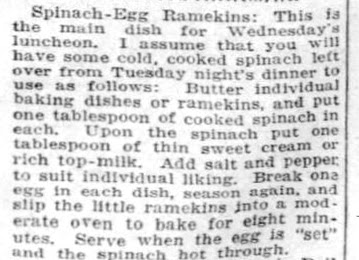
Spinach-Egg Ramekins: This is the main dish for Wednesday's luncheon. I assume that you will have some cold, cooked spinach left over from Tuesday night's dinner to use as follows: Butter individual baking dishes or ramekins, and put one tablespoon of cooked spinach in each. Upon the spinach put one tablespoon of thin sweet cream or rich top-milk. Add salt and pepper to suit individual liking. Break one egg in each dish, season again, and slip the little ramekins into a moderate oven to bake for eight minutes. Serve when the egg is "set" and the spinach is hot through.
"Efficient Housekeeping" By Laura A. Kirkman, Fort Worth (Texas) Star-Telegram morning edition p. 7, July 6 1925

Spinach-Egg Ramekins
   Multiply the ingredient amounts by how many you are making.
1-2 tbsp leftover cooked spinach (or frozen spinach, thawed and drained)
1 tbsp half-and-half or milk
1 egg
Salt, pepper, and other seasonings to taste

Heat oven to 350°. Grease individual ramekins or custard cups. If you don't have custard cups, you can use a cupcake pan with paper liners.
Put one to two tablespoons of spinach in the bottom of each baking dish, seasoning as desired. Pour one tablespoon of milk over each of them, and then add salt and pepper to taste. Crack an egg into each custard cup.* Season again as desired.
Bake 8 minutes, or until the egg is set. Serve hot.

*If using cupcake pans, you will want to crack each egg into a small bowl and carefully pour it in, rather than just cracking the egg right over the spinach. That way, you can more easily prevent some of the egg spilling down the back of the paper liner and onto the metal pan, which would be irksome to clean after baking.

Source: "Efficient Housekeeping" By Laura A. Kirkman, Fort Worth (Texas) Star-Telegram morning edition p. 7, July 6 1925

I kind of love how presumptuous Laura A. Kirkman, author of the syndicated column "Efficient Housekeeping" and giver of today's recipe, is. She has not only decided (without asking) that I, the modern housewife of 1925, devotedly follow her menus ("Sorry, my dearest husband, 'Efficient Housekeeping' didn't schedule your favorite dinner until next week!"), but she has also planned my leftovers! How am I supposed to make today's luncheon if my husband ate all the leftover spinach last night, Laura Kirkman? And what if my loving family polished off the entire spinach tureen (you just know it was served in a tureen) when I served it for supper, ruining the ramekin-based plans for today? 

We may not be following the "Efficient Housekeeping" schedule in this house, but we did purchase frozen spinach. We also have a lone custard cup that now lives with the bowls after all its siblings presumably cracked and went on to the municipal hereafter. 

Even in this tiny thing (the smallest oven-safe object I could find without gambling on whether a porcelain teacup will survive the oven), one tablespoon is not a lot of spinach.  I'm going to assume that Laura Kirkman means "one tablespoon ish but use your best judgement," not a home-economics class style perfectly level measurement using proper measuring equipment. We ended up using about 1½ tablespoons, or "one heaping tablespoon" as one might prefer to say.

In an attempt to put the "efficient" in "Efficient Housekeeping," we chose not to obsessively fret over deploying the perfect seasonings. We instead shook some seasoned salt over the spinach cup and thus finished seasoning this recipe in five seconds. 

I looked up Laura A Kirkman, and she appears to have vanished into the newspaper archives of yesteryear. She doesn't even have a two-sentence Wikipedia article with a flag on top inviting you to help Wikipedia by expanding it from a stub. Her (apparently) only foray into something more permanent than a newspaper column is a recipe book published in 1929 called Bridge Refreshments. It has my new favorite opening sentence of any cookbook: "In conducting a daily cooking column for a chain of newspapers for ten years, the writer of this book came to the conclusion that one great need of the housewife of today is an answer to the question: What Shall I Serve For Bridge Refreshments?" 

Any housewife of 1929 buying the new cookbook from the author of "Efficient Housekeeping" would no doubt have more pressing concerns before the year was out.

Anyone needing new ideas on what to serve during bridge games can read this book for free here!

Getting back to our lovely spinach, one might criticize Laura Kirkman for underseasoning everything, but keep in mind that we are supposed to be using leftover spinach which we presumably seasoned the first time we cooked it. Perhaps we even used bacon fat in our spinach recipe. Having seasoned our clump of thawed spinach like we would have for supper, we could proceed to pour a spoon of milk into the cup, making this look like small portion of creamed greens.

And so, we happily arrived at the big moment when this recipe finally becomes all it was meant to be: it was at last time to crack an egg on top! One could argue that today's spinach creation has a direct line to the many, many recipes of ancient Rome in which you put everything in a baking dish and break eggs on top to bind it all together. Or perhaps every civilization has independently come up with egg-topped baked things, just like every culture on Earth has some form of individual-sized meals encased in bread.

I considered sprinkling cheese on top of this before baking it, but I wanted to try this recipe as written. After all, what is the point of making new recipes if you're going to change out all the steps and ingredients you're not already used to? Besides, like pouring melted butter over lobster, burying this under cheese feels like cheating. Anything will taste good if you put enough cheese on top. I wanted to know if baked eggs over spinach are good on their own. As my pre-pandemic figure slips ever farther away from me, I am always looking for more ways to serve vegetables that are good for you without being punitive to eat.

One might think I was extremely extravagant if I heated up the entire oven just for one little cup of egged spinach, and I would agree. But since one can easily slide a small glass cup between baking pans, I baked this when we already had a few other things in the oven. The spinach ramekin easily slid between all the other pans on the oven rack. 

I didn't start making our little spinach ramekin until after I had gotten everything else in the oven and cleaned up every countertop splatter that I had made that evening. I thought that with such a short cooking time, surely the spinach ramekin would be ready long before everything else in the oven was. But at the end of its specified 8-minute cooking time, the egg white was still as transparent as when I cracked it onto the spinach.

Everything else I was baking was done before this was, causing me to feel an annoying guilt twinge every time I looked into the vast empty oven containing one tiny glass cup. But at least we didn't expend all the energy required to heat the oven up solely on the spinach's account. We merely delayed turning off the oven for a few minutes.

As someone who didn't get my food tastes from letting expensive people tell me what to like, I never got the taste for eating runny eggs unless they are in cake batter. I will never forget the look of withering scorn I got on some camping trip (this was before I vowed to never be more than two minutes on foot from a flushing toilet and a hot shower). In the same ignorance that led me to send raw steaks back to the kitchen in restaurants before I decided I don't like steaks anyway, I told the person poaching eggs one mosquito-filled morning that I wanted mine cooked until quite firm. Where I'm going here is that I baked a perfect soft-set egg and it was wasted on me.

I have a theory that semi-set eggs superseded hard-boiled ones because they are so much more photogenic.

If you like poached eggs that are almost but not quite set in the middle, this recipe is perfect for you. I also can't help wondering if the recipe's 8-minute cooking time could have been correct had I put the custard cup in a pan of boiling water instead of inserting it into the oven undressed. 

But this recipe gives you exactly what is promised.It's kind of like a spinach quiche with more visual flair and without the bother of making a crust for it. I was afraid that it would be nothing better than a clump of soggy spinach under a cooked egg, but it seems the egg and the milked spinach commingled just enough to unite into a very nice baked whole. I might add a bit of Tabasco sauce or a shake of cayenne to the next round of these, but they're still very good without. I don't think this is worth firing up the oven during the hot weather. But if you were already baking, these are very nice to slip onto the rack next to everything else.

Monday, August 3, 2020

Herbed Potatoes and Carrots: or, Making dinner without using any dishes at all

How many of us ever pause to appreciate the pipes in our house until they break? We have suffered a minor plumbing failure which expanded. The plumbers crawled under the house thinking they would fix a minor leak. They re-emerged through the floor hatch and said that actually, the pipes to the other part of the house need to be replaced too. They later emerged from working on the other pipes to say they'd found some other spots, and.... well ultimately it turned out that all the plumbing in the house was held together only by rust and dumb luck, and had to be taken out immediately because it should have burst in the walls a few years ago. Among other things, this meant that we had no running water in the kitchen. But running water or no, we all still have to eat, right?
With that said, we at A Book of Cookrye have been adapting to dishless cookery.

Zero-Dirty-Dishes Potatoes and Carrots
1 pound fingerling potatoes
1 pound baby carrots
1 splash of cooking oil
Rosemary, paprika, garlic powder, and onion powder (or spices to taste)
Salt to taste
1 egg per portion, optional
1 handful shredded cheese per portion, optional

Heat oven to 350°. Line a square pan with foil, then spray it. Alternately, fold the foil to make a pan, and set it on top of a sheet pan for baking (You can make individual pans to divide this into portions before you've even baked anything).
Put the vegetables in the pan. Pour the oil over them and toss with your hands to coat. Shake the seasonings over them and toss to coat again.
Bake until the potatoes are done. If desired, remove the pan from the oven when everything is very nearly cooked. Crack an egg over it, sprinkle on a handful of shredded cheese, and return to the oven to finish baking.

Dishless cooking as practiced here at A Book of Cookrye seems to involve a lot of potatoes. We have microwaved them, baked them, and attempted all manner of things to make it seem like we have variety in our lives.
Today we attempted to be fancy and toss them in spice-infused oil. Now, it's true that the oil tastes better if you steep the spices for a day or two. But if you didn't remember to put the spices in the oil early enough to allow time to infuse, you can put it in the microwave until piping hot and get the same marvelously flavored result.
This quick-infusion (which works just as well as- if not better than- leaving the oil and spices to sit for a day or two) typically involves a microwave-safe cup which then has to be washed. If you think we get twitchy about washing dishes without a dishwasher, you should see us when the only running water is a garden hose that the neighbor mercifully threw over the fence. I have actually snatched ceramic plates out of people's hands and pointed to the stack of paper ones on the counter. Anyway, going of the idea that you can microwave paper plates, we thought we could microwave-infuse the oil in this paper cup with the adorable little squirrel on it.


We tend to like a lot of lovely spices on our spuds when we cook them this way. Believe it or not, there's a decent allotment of cooking oil under there.

We gave it a quick stir with the index finger and put it in the microwave. As you can see, we added so much paprika that we dyed the oil a very dark color. A lot of recipes seem to use a parsimonious amount of paprika just for the color, but we think it's delicious. There's only 2 or 3 spoons of oil in there, so we figured that 15 seconds would probably be plenty of time for things to get nice and hot.

It turns out it's quite the mercy that we microwaved the oil for such a short time because we opened the microwave and a massive smoke cloud attacked us right in the eyes. We're only showing this so that you can learn from our mistakes and never try to microwave paper cups. You will end up frantically rushing out the door so it can smolder outside instead of smoking up the kitchen.
Thank heavens this house has a back door in the kitchen which we can run through with smoking failures.

Fortunately, while we had burned off the oil and a lot of spices, we had at least avoided wasting the actual main ingredients of dinner. But first, we merely needed to temporarily pause our food production and frantically open windows and bring out box fans because we had just reenacted this card we sent to our brother when he called and bemoaned having to march outside due to burning popcorn:
We actually passed this around and had all our friends sign it before mailing it out.
 Fortunately, the principal ingredients of our dinner still looked like this: happy, colorful, and (most crucially) not burnt.

So, dropping our misguided microwave notions, we just dumped everything on the spuds and carrots, tossed them around a bit with our hands to coat, and inserted it in the oven. Hopefully the magical smell of spuds and herbs would cover up the odor of burnt failures.

We were hoping for these to be nicely browned and enticing. But instead we only got shrinkage. We figured they were ready when you could stick them with a plastic fork without snapping anything.

Now, as this water outage is ongoing, we've been making quite a few batches of carrots and spuds. It's very convenient, and if we copy that lovely recipe from Canada and crack an egg on top, it's a complete(ish) dinner.

Now, no dinner is complete without dessert, especially when you're stressed because there's smelly rags piling up in the washing machine and crusty plates festering in the sink while you yearningly stare at the shower and fondly wait for it to bless you with scalding water again. But do we have a brownie recipe that doesn't involve dirtying a lot of cooking utensils?

Blessed be our former teacher for sending us this recipe! We had previously thought mixing it in the pan was silly and that it'd be so much easier to really give the batter a good hard stirring if we had it in a bowl. But today, this brownie recipe makes perfect sense. We snapped two plastic spoons before it was mixed, but we got perfect brownies.

And to make things even better, the only dirty dish we had was this one measuring cup, which we we merely wiped with a paper towel and put away.

Dinner is made, dessert is served, let us now rest and hope we're using the real plates next week!

Thursday, December 31, 2015

Vanilla Pudding: or, A Book of Cookrye welcomes the new year

2015 is drawing to a close, meaning in just a few days we at A Book of Cookrye will have to cross out the last digit of "2012" and replace it with a 6 instead of a 5. We at A Book of Cookrye made a very simple New Year's resolution in January:

Like many people who make New Year's resolutions, we completely forgot about it shortly thereafter. Besides, we live in an area where transit is so sparse one must make quite a detour to use it. However, as the last week of December arrived, we thought to ourselves "A whole year and we couldn't get on a train once?"
Vanilla Custard
3 eggs
¾ c sugar
¼ tsp salt
2½ c milk
1 tsp vanilla

Beat eggs and sugar in the top of a double boiler until uniform. Add salt and milk. Put over hot water and cook, stirring constantly, until thick. Remove from heat and add vanilla. Press plastic wrap onto the surface (this prevents a skin forming) and let cool.

Adapted from source

While many people's resolutions involve a workout regimen to forget about within two weeks or some other self-betterment to be hastily given up on, we at A Book of Cookrye made a resolution involving eggs and sugar.
SELF-IMPROVEMENT HERE WE COME!!

As we at A Book of Cookrye look back on 2015, we see hours of calculus (so many we burnt the book and poured a salt circle around the grill afterward just in case-- this is not a joke) and other classes we did our best to ignore. 2015 saw the death of our mixer, the theft of our only teacup, and the cracking of our only bowl. 2015 also saw our discovery of pink cherry-lemon cake, zucchini bread (which we've never made before), and the surprisingly good cucumber-lemon bread (because cucumbers look the same as zucchinis DON'T JUDGE ME).
This was runnier than anything purporting to turn into a custard had any right to be.

2015 was as good a year as any for us, on average. So, on this cold day on late December, we wonder what 2016 brings. We could wish for world peace and stable funding for libraries, but people wish for those every year and they have yet to happen. So instead we wish for things on a smaller scale.

In 2016, we would like any of these:
  • A working dishwasher where we don't even have to pre-rinse anything
  • A domicile where no one thinks our razors are community property unless we hide them
  • Sudden transmission outages when news networks or websites are trying to up their ratings by fearmongering and inciting panic or outrage
  • Increased transit in the United States so people only have to own a car and drive it if they want to
  • A pay raise

Aside from being comparitively runny, it passes for mayo.

And here is our 2015 resolution, all ready to take on the train and go! We are pleased to note that this is a repurposed jar of light mayonnaise. (Those who worry about us chucking out the contents of an entire jar of mayo: rest assured, it was rehomed to a plastic container and returned to the refrigerator.)
By the way, Our Mom of Cookrye endorses Duke's Mayonnaise and will admit no other in her refrigerator.

However, it turns out that mayonnaise jars do not hold pudding well, as we found out when we checked the back of our bicycle upon reaching the station.

Fortunately, a few spoonfuls remained in the jar. It's hardly the experience of snarfing down a generous helping of pudding from a mayonnaise jar we hoped for. But ultimately, we did our resolution the same way we do everything else: half-assed and at the last minute.

As it is, we're ending 2015 just like we started it: blissfully stupefied on Christmas leftovers. Happy 2016, everyone!