Wednesday, May 23, 2018

Cookies from a Slovakian stranger!

Sometimes when you're far from home, the recipes you make come from even farther away. One of my friends received this recipe from an online friend in Slovakia:


Hearts with Pink Fluff
    Cookies:
1 c + 2 tbsp butter, softened
1 c + 1 tbsp powdered sugar
1 tbsp rum or rum extract
1 tsp vanilla
1 egg
1½ c flour (bread or all-purpose)
1 tsp baking powder
1 pinch salt
    Icing:
1 egg white
2 tbsp powdered sugar
3 tbsp lime juice
⅔ c raspberry jam (set aside 2 tbsp)

Mix butter and sugar. Add rum, vanilla, and egg. Beat smooth.
Add flour, baking powder, and salt. Mix well. Cover and chill for about an hour.
When ready to make the dough into cookies, heat oven to 350°. Grease a baking sheet or line it with parchment.
Roll out the dough until half an inch thick. Cut out hearts and put on the pan. They will expand a bit more than most other shortbread-ish cookies, so be sure to leave each one a little bit of extra space. Bake 10-12 minutes.

    To make the icing:
Warm 2 tbsp of jam just enough to make it a bit thinner, then mix it with the lime juice. Whip the egg white to stiff peaks. Sprinkle the powdered sugar over it and beat it in. Then fold in the jam and lime juice.
Put the meringue and the remaining jam in separate bags and pipe decoratively onto the cookies.

Source: Friend of a friend

First of all, isn't punctuating every other sentence with a smiling face adorable? Second, I must say I find the mixing of metric and tablespoons to be very amusing in light of having seen a lot of bitter nerd rage spewed in online forums over metric vs customary. Fortunately, a kitchen scale was at hand! You can see it under the measuring cup, because I was writing down the cup measurements in case I want to make this recipe without one.
Interestingly, my friends do not have a canister of salt like most of us do. So, we're using the fancy pink stuff instead. Don't tell anyone, but even though it looks prettier sprinkled over things I can't taste the difference.

But what really marks this recipe as non-American to me is the use of liquor as a flavoring. Perhaps we in America haven't recovered from all the Demon Rum speeches that culminated in Prohibition, but I rarely see any recipes that use any form of alcohol as flavoring unless it is the main flavor. Or at least, I don't see alcohol used on equal footing with other flavoring extracts in realistic cookbooks. You see the odd teaspoon of brandy or tablespoon of whiskey (whisky?) in a handful of recipes in those coffee-table volumes of food porn (you know, the ones on the stand at Williams-Sonoma), but people tend to purchase those books more to admire the photographs than to cook out of (a pattern interestingly described in this 2010 celebrity cookbook review). You do see the wine, beer, and liquors used right alongside seasonings and extracts in American recipes up until the temperance brigade gained popularity. Apparently other countries (or at least, some person in Slovakia who sent a friend in Carolina this recipe) don't have the same alcohol-related hangups, otherwise we wouldn't be adding a spoonful of rum to raspberry-lime cookies.
Absent any rum, brandy was used instead.

To my minor annoyance, my friends have no printer (which seems to be getting more commonplace these days), and therefore we were looking at this text off of a smartphone. I know a lot of people do that, but I personally get very annoyed after I keep having to read a recipe off a screen the size of an index card without accidentally tapping the wrong spot with my floury hand and making the phone close the recipe and do something completely random. So I decided I would measure out everything all at once and thus not have to constantly re-check what the phone said.


My first mistake was dumping all the first things in the bowl. Whoever typed this out just said to mix them. I should have realized that people giving recipes to friends often skip obvious directions if they know the recipient doesn't need to be told every step. Of course, we didn't mix anything so much as end up with butter lumps swimming in random stuff.
Fortunately, we could switch to a whisk and bash things to-- if not completely mixed, at least nearly so.
Looks like yellow cottage cheese, doesn't it?

I wasn't at all worried at the sight of this. You see, I hadn't added the egg yet, so there was nothing to force all these things to stay mixed. Therefore, presumably, so long as we didn't have any large chunks of stuff floating around in there, it would all mix right together--- right?

Very right! Furthermore, this tasted fantastic! The slight hint of rum (well, brandy but we can pretend) added a nice subtle taste to the vanilla. Let's roll, cut, and turn these into tasty cookies! I thought I had seen a stash of cookie cutters in the very back corner of one of the cabinets. However, dragging it out from the depths showed it to actually be a lot of various craft supplies, none of which would work for cutting cookies. And so, a shotglass was brought into service instead. We could have used a regular glass, but they were all so big that we would have only gotten 7 or 8 cookies out of this whole batch of dough.

For those trying this at home, a shotglass cuts out adorably dainty-sized cookies. They come out small enough to be cute, but still big enough not to disappoint when you eat them. However, since you're cutting out such little cookies, the dough doesn't have enough weight to fall out of the cutter on its own. Since you obviously can't push it out (at least not without cutting off the bottom of the glass), you should have a can of cooking spray on hand to spritz inside the glass every so often. Even then, they will be kind of fussy to get out of the glass.

Aren't they cute and puffy? We almost didn't get to ice any. A lot of the cookies mysteriously vanished while we were waiting for them to cool off. Just as well, it turns out one egg white doesn't make an awful lot of icing. Which is just as well by me, since this isn't a huge batch of cookies.

Once we added the sugar, the egg whites stood up very nicely. Given that my friends have no cookie cutters, I was not surprised that they also have no icing-bag tips. (It's like I own any myself.) No matter, we could easily put this in a little bag with the corner snipped off.

Here, we at A Book of Cookrye want to recommend actually reading the recipe perhaps more than once before you make it. I didn't realize you're only supposed to put 2 spoons of the raspberry jam into the meringue, and instead dumped in all of it. Adding that much jam removed all chance of the fluffy stuff standing up in jaunty peaks.

Giving up on the whole piping business, we just sorta dropped the stuff off a spoon onto the cookies. It mostly stayed where we wanted it to, and actually managed to accidentally look cute. Also, the icing lasted a bit longer than you might think-- if you kept the cookies in the refrigerator, the jam re-hardened and kept it from deflating and drying out.

As for the taste? These are really good! The raspberry-lime icing is really fruity, and the cookies have a nice subtle sweetness and interesting flavor. Rolling out the dough really thick like the recipe said was a good choice. The cookies didn't dry out in the middle, but stayed delicate and fluffy as the recipe name promised. Do try these!

Tuesday, May 22, 2018

Beaten Biscuits: or, Extremely vigorous use of expensive power tools

Today, we at A Book of Cookrye present a visit to someone else's Carolina kitchen! As aforementioned, we somehow made it through airport security and thus flew out to visit friends. What should we see tucked away in the kitchen in its own little cabinet, sitting under its very own little (quilted!) jacket, but....

Indeed, while I am using an extremely old stand mixer (which you can see here), the lovely people I am visiting own that standby of people with more spare kitchen money than I have: a KitchenAid mixer.
I'm somewhat surprised at how long KitchenAids have been display appliances. Other brands have gone in and out of style, but for whatever reason KitchenAids have held remained essential display pieces for any trophy kitchen long after people stopped putting Cuisinart food processors or Jenn-Air stoves under spotlights for guests to admire.
At any rate, the pocket on the mixer's little jacket held the whisk and the dough hook, so we at A Book of Cookrye decided to see if this thing runs well enough to make one feel less bad about how much it costs. And so, we decided to make...

Kentucky Beaten Biscuits
2 c flour
3 tbsp butter or shortening
1 tsp salt
Milk or water

Heat oven to 350°.
Mix flour and salt. Mix with butter, adding just enough milk or water to make a stiff dough.
Knead for a very long time. If doing this with a mixer (and unless you really love hand-working bread, you should), set it to a higher speed than you usually would for kneading- so the dough really gets thwacked and flung around in the bowl. The dough will toughen, then get soft and slack again. The dough should also form blisters when you work it. Believe it or not, it is possible to overwork the dough, so as soon as you have a pretty good amount of air bubbles forming, stop the machine.
Roll out thin and cut*. To prevent the dough from sticking, generously coat it, the rolling pin, and your rolling surface with cooking spray. Pierce each biscuit three times with a fork.
Bake til nice and golden. The inside should not be doughy at all when you break one in half.

*It honestly would have been a lot easier to roll it into balls and pat each one flat.

Source: Woman's Club of Fort Worth Cook Book, 1928 (submitter: Mrs. L Simpson)

It is very fitting that we should make such a southern thing while en voyage to the deep South. If you do an internet search for "beaten biscuit," you will find lots of articles calling it one of the oldest and most ancestral of Southern foods. A lot of articles talk about how they went out of style because the dough was so much work (like, over an hour of kneading) to make. But now that we have electricity in nearly ever home, are these something that we should bring back into the kitchen?
Mostly, I wanted to test-drive the KitchenAid. We have the commercial model in cooking class, but this is the first time I've ever encountered the home version. And what better way to test it than by using a recipe usually written with violent instructions?

You see, the "beaten" in the name "beaten biscuit" is apparently no exaggeration. You know how if you overwork bread dough, it becomes tough? It turns out that if you overwork it enough, it gives up and goes slack again. If you're doing it by hand, you'll have extremely tired arms by the time you're done kneading it.
Various articles picturesquely described folding it and whacking it with axe handles or similar lethal household objects. But we at A Book of Cookrye were not about to wear ourselves out in the name of cooking when we could just turn on an expensive device and let electricity do the hard work for us.

To speed things up, and because all the articles romantically described people flinging and thwacking the bread dough about, we turned the mixer speed up a lot higher than anyone usually should when attempting bread. Did you know that if an electric mixer wants to, it can walk all over the counter? As the dough slapped and whapped around in the bowl, the mixer started a moderately-paced journey across the countertop. Had it not shown an almost suicidal desire to drift toward the counter's edge, I might have let wander just to see where it wanted to go. Instead, I ended up spending about 30 minutes (really, I was checking the clock) holding the wayward machine in one place while the vibrations went from the mixer to the counter up my arm and then rattled my skull.
The dough ended up oddly creamy and spongy. I have never seen biscuit dough look like this before. It almost looks like cake batter, if cake batter could hold a shape instead of just pouring out.

Imagine if you will an unusually soft Silly Putty. It even managed to go lighter in color than before we started the motor. Also, you can see the blisters that the original recipe said we should be looking for.

The recipe said to roll the dough out and cut, presumably in circles. Which a lot of people do, but I never liked how often you end up having to reroll the dough over and over again to make biscuits out of the scraps. So when no teacher is standing over me reminding me that I am terrible at presentation, I usually just cut biscuits into squares. They're not as cute, but you have all of your dough cut in one go.

 However, this dough was really floppy, and almost gooey. It was not the easiest thing to lift and put on the pan. Incidentally, I wondered if I hadn't rolled them too thin- they looked more like crackers than biscuits. So with batch #2, I stacked them two dough-pieces high to see if semi-thick biscuits were better than really thin ones.
\

My beaten biscuits look like weird sea creatures swimming on the foil! Maybe I shouldn't have tried to roll and cut them. These are the most badly freehanded attempts at bread I have perpetrated in a long time.

As you can see, they actually have little layers and tiny air bubbles in them! However, these took a long time to actually finish baking. The center was gummy and doughy a lot for a longer than a one-eighth inch piece of dough in the oven should be.

Now, we can surmise why biscuits that take multiple hours of work to make disappeared from kitchens. But I would advance the theory that they stayed out of style long after electric mixers became commonplace because, honestly, they're basically just really sturdy crackers. They're pretty good crackers, but announcing you made homemade crackers doesn't get quite the same happy reaction as homemade bread.
So, if you love making little cracker canapés but get annoyed that the crackers always break and crumble, this recipe is for you. Otherwise.... well, imagine choosing between a plate of fluffy biscuits and a plate of these.

Sunday, May 20, 2018

A Book of Cookrye flees the state

We at A Book of Cookrye have been meaning to visit friends out in Carolina, and have been obsessively watching airlines for discounts. We found a 50% off sale, and so...
Let's hear it for tiny plastic cups of Diet Coke!

To Carolina!

Saturday, May 12, 2018

Applesauce Cake: or, Tasting the 20s

You will never believe what I somehow got my hands on!

Yes indeed, the 1920s cookbook I scanned a lot of pages out of from my library's Special Collections turned up for sale online! What's more, it was priced like a used book and not like an antique, so I could actually afford it! There was just one teeny little problem...

I'm surprised that my copy was falling apart while the library's copy remained intact. Theirs is covered in pencil notes, handwritten recipes, recipes cut out of newspapers and tucked in the pages, and other signs that someone cooked out of it a lot before it landed in an archive. This copy has no sign at all that anyone ever so much as opened it on a kitchen counter, so why is mine the one that's falling apart? Maybe the library had to give their copy surgery a few times too.
But, all was not lost! I used to work in a library, so I am very familiar with the existence of library book mending departments. Several phone calls to various universities later, a very nice person agreed to fix it for me at no charge. Do you know how much book repairs usually cost? It's both 1) a very skilled trade, and 2) an increasingly rare one. The only thing I had to do was spend a long time waiting to get the book back, because they were going to have to do it when the library had relatively few books in line to get fixed.
I gotta say, it's so nice to be able to flip through the book whenever I want, without worrying that the library will want it back soon. I notice little things like this, which I'd never have seen if I was worried about having to imminently hand it back:
Why doesn't this recipe have someone's name under it? You just know anyone who thought to send in a recipe for sausage spuds to a serious fundraising endeavor was fun to be around.

But we're not making meat-stuffed potatoes today. We're flipping to my favorite part of any cookbook: The desserts! And we are making....

Small Applesauce Cake

1 c hot applesauce
1 c sugar
1½ c flour
1 tsp soda, dissolved in ⅓ c water
½ c raisins
½ c walnuts*
½ c coconut
1 tsp cloves
A little nutmeg

Heat oven to 350°. Grease a round or square cake pan.
Mix applesauce and sugar, then add the spices. Add the flour in three additions, alternating with the water which you add in two. A whisk will work better than a spoon for getting out flour lumps.
Stir in the coconut and raisins.
Pour into the pan and bake until done, about 20-30 minutes.

*Never liked walnuts in cake. So these stayed right out.

Source: The Woman's Club of Fort Worth Cook Book, 1928 (contributor: Mrs. Belle S.  Brown)
Substituting applesauce  for butter in cake and cookie recipes has been making the diet-advice rounds for a while now, but I don't think it was something people did to try to make desserts less fattening in 1928. Therefore, one can assume that we're using applesauce instead of butter in this cake for the flavor, and not because it is supposedly more slimming. In theory, Mrs. Belle S Brown (one of the few married women in this book who gets her own first name printed) made this cake because she wanted a cake that tasted like apples, and not because she was trying to lose weight without completely sacrificing cake.
Actually, a lot of people apparently liked applesauce cake at the time.  Kind of like how modern-day community cookbooks usually have multiple recipes for banana bread or for lasagna, the desserts chapter of this book has a lot of applesauce cake recipes. At any rate, it seemed a promising sign that the cake would come out really well.
Note the recipe book in the back, which is no longer falling apart.

We happened to have this strawberry-applesauce in the refrigerator that kinda got forgotten, so that's why applesauce is so pink. Also, the applesauce-sugar residue that stuck to the measuring cup tasted absurdly good.
I don't know why the applesauce had to be hot, but it wasn't too much extra effort to pop the bowl in the microwave.

As happens a lot in community cookbooks, there are literally no instructions. (Could be worse, some recipes in this book don't list all the ingredients for some reason. Maybe the missing things would have been obvious to anyone cooking in 1928.) But we at A Book of Cookrye haven't made it halfway through an associate's degree in cooking without learning a few things about cake mixing.

And so, we figured we'd do the method where you cream the butter (here replaced with applesauce) and sugar, then alternately add your milk (here replaced with water and baking soda) and flour. It worked all right until we added the first splash of soda-water. Please note 1) the lovely pink color of the batter and 2) how low in the bowl it is. There isn't even enough batter to completely cover the business end of the spoon. Now have a look below.

Yep, the batter fizzed up almost like those baking soda-vinegar volcanoes we all did. And it turned a really ugly, nasty shade of gray. The fact that the batter apparently did all its rising in the bowl made me worry about how this cake would come out of the oven. If I stirred all the bubbles out of it getting the rest of the flour and stuff in, would it stay flat the whole time it baked?
I wasn't worried about the color (mainly because I figured once your cake goes to gray, it will stay there so you may as well embrace it), though I did kinda hope the spices might dye it at least a little bit brown.


And now we add the last two things! I was actually oddly excited about putting in coconut in this. Apple and coconut seem like they'd go really well together (assuming you like coconut).

That is one ugly cake, isn't it? The coconut is not doing it any favors. It looks like either little white bugs or like the batter was really lumpy and I baked it anyway.  At least it turned a decent shade of brown on top.

The cake did at least get a little bit color to it in the oven. The coconut still likes little lumps of something that shouldn't be in there, though. Also, despite my fears, it did in fact rise like a cake should.

As for the taste? It's really dense like gingerbread, and marvelously apple-y. You can just leave the coconut out. You can't taste it, and all it does is get stuck in your teeth. However, it is really good. I'm planning to make this again, only using a lot more spices. Since it is dense like gingerbread, and kind of tastes like it already, we may as well not try to pretend it's a cake.
Also, this got a lot better after aging about two days. I had it in my locker so I could have a snack between written tests, and it got a lot better toward the end of finals week.

Tuesday, February 20, 2018

Lots of cakes: or, A Book of Cookrye experiments on friends!

As has been somewhat frequently mentioned, we at A Book of Cookrye are now in cooking school, trying to eventually get paid to do something we like. In baking class, we've spent a lot of time (obviously) making cakes. This has come with a lot of lecturing on the chemistry of cakes, and so much physics I almost expect to see Greek letters appear on math formulas again. Much use has been made of phrases like "incorporating air cells," "activating gluten," "coagulating egg proteins," and "emulsifying fats."
Which brings us to mixing a cake! Did you know how many fascinating physics are happening in your mixing bowl (all of which I had to memorize for a test)? Did you know how many ways there are to mix the a cake? Multiple methods were mentioned in class (there are practically as many different ways to mix a cake as there are cake recipes floating around online), but we in class only looked at a  four.
"It makes such a difference!" the teacher insisted. "If you don't believe me, go home and try them all at on the same recipe!"
We at A Book of Cookrye were very skeptical indeed. How much difference can it make unless you do something wrong like overbeat it until the flour toughens up everything? Therefore, because it involved a lot of cake and also a lot of experimenting, we were more than willing to test this.
However, if you're going to try four cake-mixing methods, you will end up with four cakes. As we no longer live in a dorm with people to give baked goods away to, what would we do with four cakes? We then got invited to a friend's house party. Which brings us to today's recipe:
All Electric-Mix Recipes Prepared Specially for your Dormeyer Mixer, 1946

We've run this recipe before. Since know how it comes out when you make it as the directions tell you to, it seemed as good a choice as any. Also, it tastes good, so the prospect of having four of them threatening the counterspace and my recently-successful dieting isn't at all dreadful.
Well, let's start the method trials with...

THE CREAMING METHOD
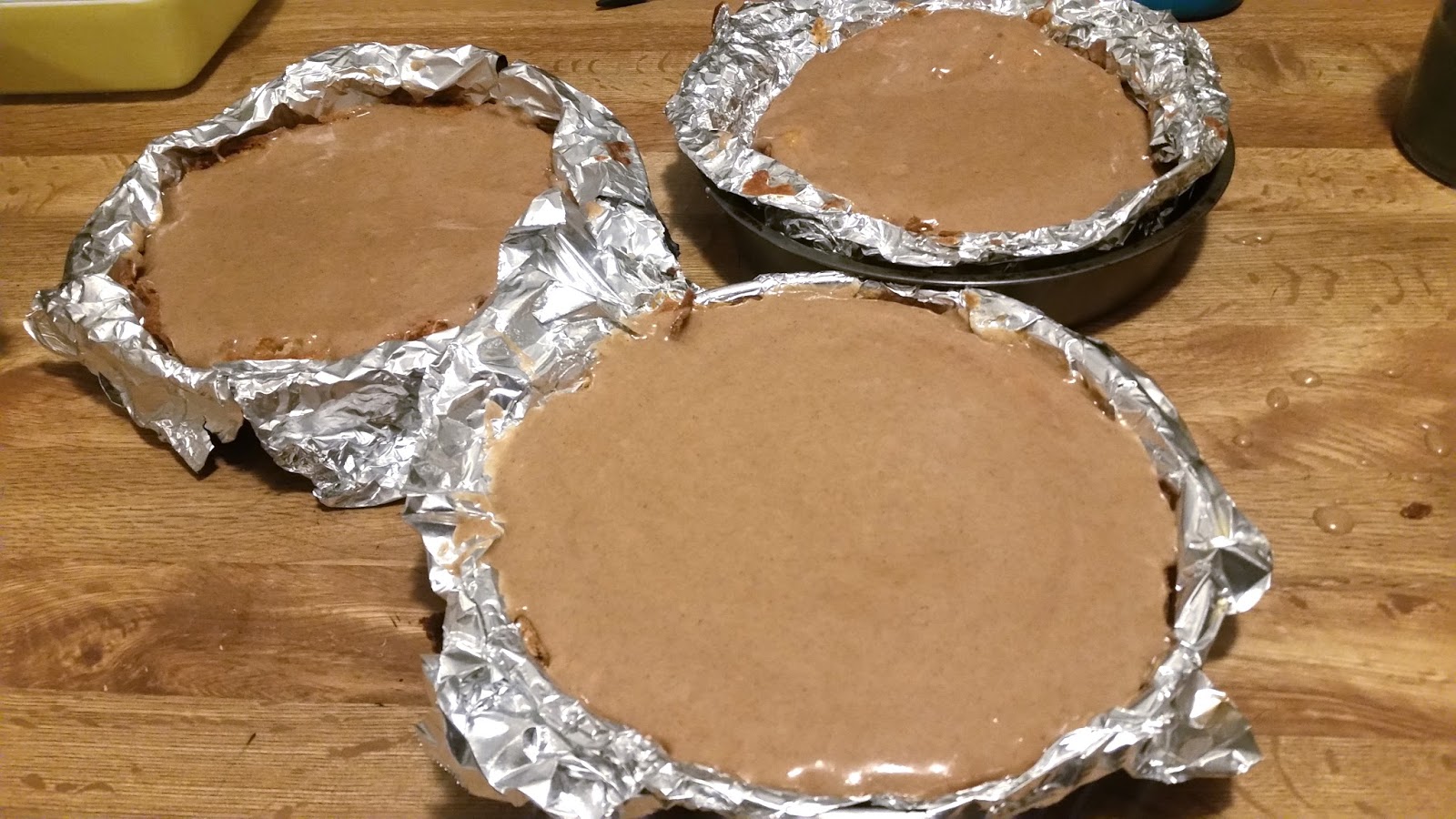
Notice the foil condom on the pan because we have a lot of cakes coming up and no dishwasher.

This one comes up the most often in cake recipes. You know, the recipes where the directions read something like "Cream butter and sugar, then beat in the eggs. When all is mixed, alternately add the flour and milk, beating just until mixed..."
We started to see compelling evidence that changing the mixing method would make a lot more of a difference than we suspected. The batter was a lot thicker than when we made it using the original recipe directions, which looked like this:

Not that the original recipe is watery-thin, but changing the mixing directions made a batter that almost did not want to spread into the pan.
While that was baking, we proceeded to...

THE FLOUR-BATTER METHOD
Apparently this produces a really good pound cake. What you basically do is mix the butter with half the flour. Then you beat the eggs and sugar until they're good and foamy, and then put the whole thing together. In class, they admitted that "This way is really old-fashioned, you don't really see it anymore." Old-fashioned? Rarely used? Of course we're going to try it!

As you can see, while the creaming-method batter was already thicker than the original recipe, this made a little mountain in the pan.

When you make the same cake over and over again in one day, you eventually stop needing to look at the recipe. If I had a dishwasher, I might have measured out all the ingredients for each cake ahead of time because I got really tired of having to do it repeatedly. But who wants to hand-wash all those storage tubs? Well, let's move right on ahead to...

THE MERINGUE-BATTER METHOD
We've actually posted a cake made like this before. Basically, you mix the flour and the butter together until it looks like you're making a pie crust. Then you add the egg yolks (if the recipe uses whole eggs), forcing them to mix into the crumbly stuff in the bowl. After that, you make a meringue out of the egg whites and the sugar, and mix that into your flour clods. Congratulations! You have a cake!

Well, that method was a lot of fuss and bother. And after having to get out so many bowls for separately beating eggs, separately combining some of the ingredients before adding them to something else, and so on, I asked myself, "Can we do this with less dishes?"
It turns out, we can! Let's move on to the one I really was looking forward to...

THE FUCK-IT METHOD
Put everything in the bowl and insert an electric mixer. If you hate having to make an effort, this will feel great.
They gave this method a nicer-sounding name in class, but I'd rather call it for what you're probably saying as you dump everything in.

We were warned that this is not the best method for cake mixing and that you have less control over the batter. The phrase "improper incorporation of air cells" was deployed. But how much difference could it really make?
I don't know where that metal plate came from, but I was very glad to find it when I looked in the oven and saw that the fuck-it cake was dripping all over the oven.

Apparently it makes a lot of difference.
Incidentally: note the planning ahead in moving the cake that was already in there to the front when adding the next one since it would theoretically come out of the oven first.

After hastily jamming the aforementioned metal plate under it, we intended to finish baking it just to see what would happen. However, it kept gushing out of the pan. You'd think eventually there'd be no more batter to spill out, but this kept oozing over, dripping out astonishingly foamy splurts.

It turns out that cake batter makes an incredibly strong adhesive, seeping under the foil to glue it to the pan, and then gluing the pan to the plate that was supposed to catch the batter drippings. You could hold it upside-down and nothing fell.

Well, let's have a look at the three survivors.

The meringue cake had this ever-so-slightly shiny top crust, the flour-batter cake was really spongy and was most likely to bend with the foil when you pulled it out of the pan rather than hold its shape, and the creaming-method cake looks... like cake.
You can really see the top crust of the meringue-cake here. It looks kind of like that top layer you get on brownies.

Before taking these cakes out in public, we decided to spend about 45 seconds stirring together a big batch of cinnamon icing, which we then dumped on all three.

And so, I brought all three cakes to my friend's house party.
Incidentally, the really great thing about lining the pans with foil (aside from not having to wash them) is that once you've arrived to wherever you were going and set the cakes down on the table, you can lift them out of the pans, stash the pans in your car, and not have to worry about forgetting them or anyone scratching them.
But what did everyone think of these? After explaining what was on trial here, I asked my friends what they thought of the cakes. Could they tell the difference? Why, yes they could!
 There wasn't much difference in taste, but as the group photo of uniced cakes suggests, they had very different textures. While everyone liked all of them, the creaming-method cake was least popular (though substantial portions of all three disappeared from the pans). The flour-batter cake was slightly drier than the creamed cake, but also lighter. The meringue-batter cake was the most popular, if we measure popularity by how much cake was missing from the pan afterward.
To my own surprise, it appears that not only does changing how you mix a cake give you a different texture, it can actually change the taste. No one specifically noted a flavor difference in the cakes, but a lot of people thought I had put sweeter icing on the flour-batter cake. Since the icing on all three was from the same big batch, that must mean the cake underneath it tasted different.
And so, I am very glad I had kept my skeptical pooh-poohing to myself in class. It turns out the teacher was right.